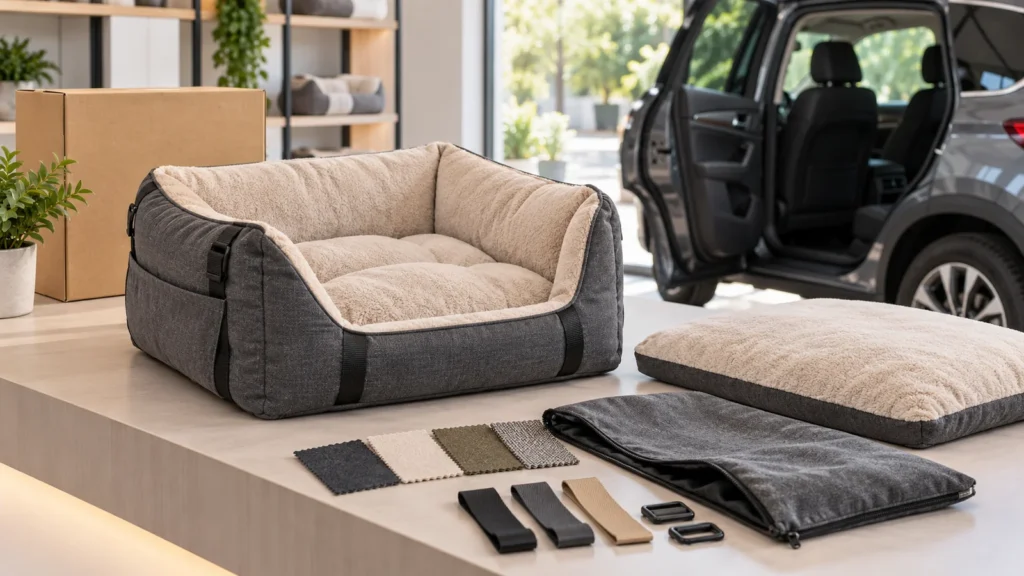
Sourcing wholesale dog car seats requires more than choosing an attractive design and negotiating a unit price. Buyers need to understand vehicle fit, usable space, attachment arrangements, cleaning instructions and packaging efficiency.
These details influence how clearly a product can be sold, how easily customers can use it and how much support a distributor may need to provide.
Product claims require particular care. A padded travel bed, a booster seat and a tested restraint system should not be presented as interchangeable products.
This guide explains how pet brands and distributors can compare dog car seats, develop private-label specifications and prepare a purchasing brief for suppliers in China.
1. Define the Product’s Purpose Before Selecting a Model
Start by identifying the intended function and customer.
Is the product primarily a comfortable travel bed, a raised booster, a protective seating accessory or part of a specifically evaluated restraint arrangement?
Record that distinction in your purchasing brief. It should guide the design, instructions and retail description.
A soft padded bed may emphasize removable covers and home-to-car convenience. A structured booster requires closer review of its support and attachment configuration.
Do not assume that padding, adjustable straps or a tether establish crash protection. The Center for Pet Safety’s historical travel-seat research illustrates why such claims require product-specific evidence. CPS Pet Travel Seat Pilot Study
Define what the product does before deciding how it will be marketed.
2. Compare Dog Car Seat Formats by Application
Suppliers may group several different products under “dog car seats.” Ask for specifications that make the differences clear.
| Product format | Purchasing considerations |
|---|---|
| Bolstered car seat bed | Usable space, padding, cover removal and attachment arrangement |
| Structured booster | Support construction, installed dimensions and configuration-specific evidence |
| Foldable travel seat | Setup, shape recovery, storage dimensions and repeated folding |
| Console-style model | Vehicle-specific fit, positioning and restrictions |
| Protective seat cover | Coverage, openings, cleaning and compatibility with vehicle features |
A seat cover protects upholstery but does not provide the same function as a bed or booster.
Avoid combining these formats into one undifferentiated product listing. For distributors, distinct positioning helps retailers explain why each SKU belongs in the range.
Select formats around actual channel needs rather than offering every available variation.
3. Specify Usable Dimensions and Pet Fit
Dog car seats for small and medium dogs need more precise information than a category label.
Request external dimensions, internal resting space, wall height and the dimensions of removable cushions.
A thick bolster may make the product appear generous while reducing its usable area. Compare the assembled sample with the specification.
Clarify how any recommended weight range was established. Weight alone does not describe the animal’s body dimensions or available resting space.
For product pages, use a dimensioned drawing and explain the intended measuring method.
Confirm tolerances appropriate to the construction. Soft-filled products may require an agreed measurement procedure and recovery period.
The same dimensions should appear consistently in the specification, packaging and online listing.
4. Review Vehicle Compatibility and Attachment Systems
Vehicle interiors differ in seat contours, headrests, belt layouts and available space.
Ask the supplier to show the complete installed configuration. Record the strap route, adjustment range and intended contact points.
Check whether the product obstructs access to vehicle controls, belt buckles or other relevant features. Confirm installation restrictions against the product and vehicle instructions.
Treat “universal fit” as a claim requiring support rather than a standard description.
Separate the components that position the bed from any components intended to restrain the animal. Their functions and evidence may differ.
Do not recommend improvised attachment points or present an unverified tether as a crash restraint.
Installation photographs should show the approved setup and match the supplied version.
5. Select Fabrics and Filling as a Complete Construction
Material names alone are insufficient for comparing OEM dog car seats.
For the outer shell, request fiber composition, construction, finish and relevant weight or thickness information.
“Oxford fabric” does not automatically establish durability or water resistance. Likewise, a coated panel does not prove that the assembled product prevents leakage through seams or openings.
For lining materials, compare texture, cleaning response, hair removal and appearance after use.
For filling, document the material, distribution and recovery expectations. Inspect whether padding shifts and whether bolsters retain their intended shape.
Evaluate the base and anti-slip backing alongside the vehicle surface used in the assessment.
Approve the complete material combination, including seams, zippers and attachments, rather than selecting fabrics in isolation.
6. Verify What “Washable” Means
A washable dog car seat supplier should explain exactly which components can be cleaned and how.
A removable cover does not necessarily mean the complete product is machine washable. Foam inserts, support boards, hardware and straps may require different treatment.
Confirm:
- Which parts must be removed.
- Whether washing is by hand or machine.
- Recommended washing and drying conditions.
- Whether inserts can be washed separately.
- How the product is reassembled.
Assess an approved sample after the agreed cleaning procedure. Review dimensional change, color transfer, seam appearance, zipper operation and cover fit.
Use care instructions supported by that evaluation.
Clear cleaning information also helps retailers answer customer questions and reduces ambiguity in online listings.
7. Plan Private Label Dog Car Seats Around a Written Brief
Private label dog car seats may involve branding on an existing platform or a broader development project.
Confirm whether the request changes only appearance or also affects construction.
Custom logo dog car seats can include printed or woven labels, embroidery, patches, color selection and retail artwork. Approve the chosen method on the actual material.
Structural changes may involve dimensions, bolsters, support panels or attachment systems. These require a fresh review of the affected requirements.
Your customization brief should identify the reference model, approved materials, dimensions, logo details, accessories and packaging.
Specify artwork versions and sample approval responsibilities.
Do not allow a material or hardware substitution to enter production without a documented proposal and buyer approval.
8. Use a Practical Sample Approval Checklist
Sample evaluation should connect appearance, usability and documented specifications.
Review the product assembled, installed, unpacked and reassembled after cover removal.
Check dimensions, padding distribution, stitching, closures, straps, adjustment hardware and accessories.
Use a structured record:
| Inspection area | Evidence to retain |
|---|---|
| Dimensions and construction | Measurements and reference photographs |
| Materials | Approved swatches and component descriptions |
| Installation | Configuration photographs and instructions |
| Cleaning | Procedure and post-cleaning findings |
| Branding | Approved logo placement and artwork |
| Packaging | Packed sample and packing arrangement |
| Performance claims | Relevant reports and scope |
Record defects and requested changes individually. Approve a revised sample where a correction needs physical confirmation.
Retain the reference sample with the matching written specification.
9. Distinguish Quality Checks From Safety Claims
A dog car seat quality inspection checklist can address workmanship, dimensions, assembly, packaging and agreed functional checks.
It does not automatically establish performance in a collision.
If a supplier claims crash testing, request the complete report and identify the tested model, size, configuration, connection system and result.
A component strength test and a dynamic crash evaluation answer different questions. Evidence for one version should not automatically be extended to every size or customized variant.
Confirm whether production changes affect the applicability of previous evidence.
Keep website language aligned with what has been demonstrated. Terms such as “safety seat,” “crash protection” and “crash-tested” should not be added simply because competitors use them.
Agree any specialist evaluation before production approval.
10. Review Packaging Volume and Product Recovery
Dog car seats can occupy considerable space relative to their weight.
Request unit packaging dimensions, master-carton dimensions, units per carton, gross weight and packing orientation.
Folded or compressed packing may improve freight efficiency, but buyers should verify recovery, shape and presentation after unpacking.
Inspect the product after the proposed packing method and an agreed storage period. Check padding, bolsters, straps, zippers and printed elements.
For illustration, a carton measuring 60 × 40 × 40 cm occupies 0.096 cubic meters. One hundred cartons total 9.6 cubic meters before any additional packing allowances.
This is a volume calculation, not a freight rate or loading guarantee.
Compare bulk dog car seat shipping costs using approved packing data rather than preliminary estimates.
11. Compare Quotations on the Same Basis
A lower unit price may reflect less filling, different fabric, simpler packaging or a narrower service scope.
Ask suppliers to quote against the same product configuration and quantity.
Separate the following items where relevant:
- Product and accessory price.
- Branding and material changes.
- Sample and development charges.
- Retail packaging and artwork setup.
- Inspection and testing arrangements.
- Collection, handling and transport services.
Confirm the named delivery location and what each quotation includes.
Compare total purchasing cost alongside product suitability. A reduction in packaging protection or support quality may create additional costs after delivery.
Keep the approved quotation connected to the final specification so both parties can identify what was purchased.
12. Confirm MOQ, Lead Time and Reorder Conditions
Dog car seat MOQ and lead time depend on the model, materials and customization.
Ask whether minimum quantities apply per style, size, color or packaging design. A mixed order may still retain separate component minimums.
Distinguish sample preparation, revision, material procurement, production, inspection and shipment availability.
Record what starts each stage and how changes affect the schedule.
For repeat orders, retain the approved references and require notification of changes to construction or materials.
Agree how quality concerns will be reported and investigated. Confirm required evidence, response responsibilities and available remedies.
A clear reorder process helps distributors maintain product consistency as the range develops.
13. Build a Focused Distributor Assortment
Start with products that serve clearly different customer needs.
A manageable launch might include a washable bolstered bed and a compact foldable option, provided their functions and specifications fit the target channel.
Avoid multiplying colors and sizes before demand is understood. Every SKU adds photography, packaging, inventory and support work.
Give each product a comparison sheet with usable dimensions, cleaning method, storage format, installation requirements and supported claims.
After launch, review returns and customer questions alongside sales.
Repeated fit questions may indicate missing dimensions. Complaints about cover removal may identify an instruction or design issue.
Use that information to improve listings and future orders before expanding the assortment.
How Pet Mobility Source Supports Your Sourcing Project
Pet Mobility Source is a B2B pet travel and mobility supply-chain partner supporting brands, importers and distributors.
Our services include product selection, supplier coordination, OEM/ODM project management, sample confirmation, quality-control coordination and export preparation.
Our pet car seat category covers travel-seat sourcing with options such as fabric selection, washable components, attachment arrangements and private-label packaging.
For each project, we review the destination market, application, quantity and customization requirements before confirming suitable options.
Buyers sourcing several compatible categories can also discuss order consolidation.
Available materials, MOQ, sample arrangements, inspection scope and delivery conditions are confirmed in the project proposal.
Frequently Asked Questions
Can dog car seats be customized with my brand?
Selected products may support logos, colors, labels and packaging changes. Structural modifications need a separate review of development and evaluation requirements.
Are all dog car seats suitable for every vehicle?
No. Suitability depends on dimensions, installation and the vehicle interior. Provide clear fit information and relevant restrictions instead of relying on an unsupported universal-fit claim.
Are removable-cover dog car seats machine washable?
Only where the specified components and cleaning method support that description. Verify the care procedure using the approved construction.
Does a tether mean the product provides crash protection?
No. A tether’s presence does not establish the performance of the complete system. Review evidence relevant to the intended claim and configuration.
What should I send for a wholesale quotation?
Provide the destination market, sales channel, reference style, dimensions, quantities, material preferences, branding and packaging requirements.
Start Your Wholesale Dog Car Seat Project
A well-planned range combines clear product positioning, appropriate dimensions, practical care instructions and documented quality requirements.
Prepare your product brief before comparing samples and quotations.
Request a project-based quotation to discuss dog car seat selection, customization, sampling, quality-control coordination and export preparation with Pet Mobility Source.