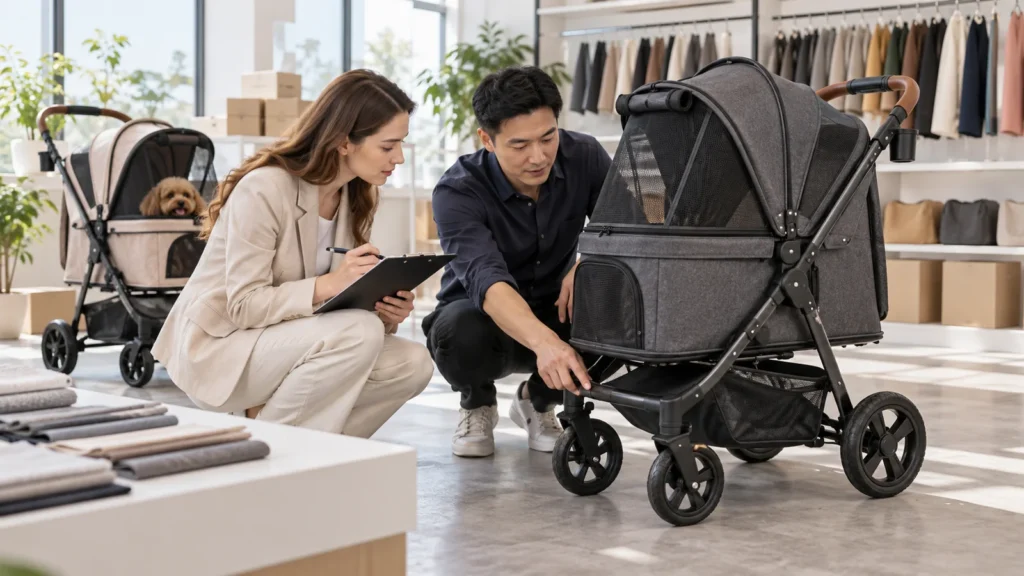
Choosing a pet stroller supplier in China involves more than comparing catalogue prices. Importers need a product that fits their market, specifications that remain consistent during production, and clear responsibility when an order requires changes.
Two similar-looking strollers can differ in frame construction, wheel assemblies, folding mechanisms, fabrics and packaging. Those differences affect the customer experience, freight cost and after-sales workload.
A practical supplier assessment connects product selection with sample approval, quality inspection and shipment preparation. It also separates promises from evidence.
This buyer’s checklist explains how to evaluate a wholesale pet stroller supplier, compare purchasing conditions and prepare a sourcing brief that supports a reliable first order and repeat business.
1. Define Your Market Before Comparing Suppliers
Start with your customer and sales channel. A compact stroller for an urban pet retailer requires a different specification from a large-dog model sold through specialist distributors.
Identify your intended positioning, target retail range, destination market and initial order quantity. Then describe the functions the product must provide.
Your brief should address:
- Intended pet size and usable cabin dimensions.
- Required working load and supporting evidence.
- Folding and storage requirements.
- Expected surfaces and operating conditions.
- Cleaning and maintenance needs.
- Branding, accessories and retail packaging.
For large dog strollers wholesale projects, cabin access and usable space deserve attention alongside the load rating. For double pet strollers wholesale orders, review each compartment and the complete assembled product.
A clear brief makes supplier proposals more relevant and reduces time spent comparing unsuitable models.
2. Understand Who Will Supply and Manage the Order
A manufacturer, trading company and sourcing partner can each play a useful role. The important question is which activities they perform and who remains accountable.
If you are searching for a pet stroller manufacturer in China, ask which production stages are performed at the proposed facility and which are subcontracted. Request evidence relevant to that arrangement.
When working with a supply-chain partner, clarify how factories are selected, specifications are communicated and production issues are escalated.
Confirm the contracting entity, invoicing arrangement and payment instructions through an appropriate verification process.
Ask who manages sample revisions, inspection access, component changes and corrective action. A supplier should explain these responsibilities clearly.
Factory ownership alone does not establish product suitability. Evaluate the proposed production and management system against the requirements of your order.
3. Compare Product Platforms, Not Just Photographs
Catalogue images help identify styles, but they do not provide enough information for purchasing approval.
Request a specification sheet for each shortlisted model. Compare open dimensions, folded dimensions, usable cabin space, product weight, accessories and assembly requirements.
For foldable pet strollers wholesale purchases, review the folding sequence and storage configuration. Check whether removable components must be packed separately and whether assembly instructions match the supplied version.
Wheel size, attachment method and replaceable parts may also affect handling and support requirements.
Be careful with descriptions such as “jogging,” “all-terrain” or “heavy-duty.” Ask what design features and evaluation support the claim.
Shortlist products because their specifications match your sales channel, not because they resemble a popular retail model.
4. Use a Structured Pet Stroller Sample Evaluation
Treat the sample as a purchasing checkpoint rather than a visual preview.
Record the model, sample date and configuration. Note any difference between the sample and the proposed bulk-production version.
A useful pet stroller sample evaluation covers assembly, opening and folding, locking operation, wheel attachment, brake function, steering, fabric construction and accessory fit.
Check for inconsistent seams, poorly finished edges, loose components or unclear instructions. Evaluate the packaging too: an attractive sample delivered in unsuitable packaging does not resolve shipment risk.
Use controlled procedures appropriate to the product. Do not improvise hazardous load or stability tests; agree suitable methods with a competent provider where needed.
Create a written findings list and obtain responses to each issue. Approve the final configuration only after agreed revisions have been checked.
5. Ask How Load, Stability and Performance Claims Were Evaluated
A headline load capacity does not describe the complete product.
Ask which model was evaluated, how it was configured, where the load was placed and what acceptance criteria were used. Clarify whether the evidence covers static loading, repeated operation or other conditions.
For multi-compartment models, establish whether stated limits refer to individual compartments, the complete stroller or both.
Review test documents against the proposed product version. A report for another frame, wheel arrangement or material configuration may not support the same claim.
Likewise, a factory audit and a product test answer different questions. Neither should be presented as blanket proof of every marketing statement.
Identify destination-market requirements with appropriate specialists and confirm the relevant documentation before production. Do not assume requirements for children’s strollers automatically describe a pet-only product.
6. Clarify Private Label and OEM Customization
Private label pet strollers can involve changes to logos, colors, fabrics, labels, instructions and cartons. Structural development may involve a wider scope.
Ask the supplier to distinguish changes available on an existing platform from changes requiring engineering, tooling or further evaluation.
For OEM pet stroller customization, record the approved material, color reference, logo placement, artwork and dimensions. Specify how revised samples will be reviewed.
Discuss tooling ownership, permitted use of designs and access to production files where relevant. Put the agreed arrangements into the project documents.
A revised wheel, frame connection or folding mechanism should not be treated as a purely cosmetic change.
The supplier should explain how design changes affect cost, minimum quantities, sampling and production planning before you approve them.
7. Review MOQ, Lead Time and Change Control Together
Pet stroller MOQ and lead time depend on the model, materials, customization and production arrangement.
Ask whether minimum quantities apply per model, color, fabric or packaging design. Confirm whether mixed-model orders are possible and which minimums remain.
Separate sample preparation from production timing. Also distinguish factory completion, inspection release, cargo availability and transport departure.
Ask what starts the production schedule: deposit receipt, approved sample, artwork confirmation or material readiness.
Then agree a change-control process. A specification should not be altered during production without a documented proposal and buyer approval.
Avoid accepting substitute materials simply because they are described as equivalent. Request the details needed to assess their effect on performance, appearance and previous approvals.
8. Establish a Pet Stroller Quality Inspection Checklist
Quality requirements should be written before mass production begins.
A pet stroller quality inspection checklist may include dimensions, assembly, mechanisms, wheel and brake operation, workmanship, accessories, labeling and packaging.
Define which checks occur before production, during production and before shipment. Specify sampling arrangements, defect criteria and how findings will be reported.
Inspection results should identify the product and order inspected, the quantities reviewed and any limitations.
Agree what happens if an inspection fails. Clarify corrective action, reinspection arrangements, related costs and who authorizes shipment release.
Ask how approved materials and samples are controlled at the production site. A good final inspection is useful, but it cannot replace clear specifications and production discipline throughout the order.
9. Compare Quotations on the Same Basis
A lower quotation may reflect a different product configuration or a narrower service scope.
Ask shortlisted suppliers to quote against the same specification, quantity, packaging and delivery basis. Identify sample charges, customization fees, tooling and inspection costs separately.
Use a comparison table rather than comparing only the unit-price line.
| Quotation item | What the buyer should confirm |
|---|---|
| Product configuration | Frame, fabric, wheels, accessories and approved version |
| Quantity | Minimums by model, color and packaging |
| Customization | Included changes and additional charges |
| Packaging | Carton configuration, dimensions and protection |
| Quality checks | Inspection scope and corrective-action process |
| Delivery basis | Named location, included services and exclusions |
| After-sales support | Spare parts, claim process and agreed remedies |
Compare the commercial consequences of differences before negotiating. A useful quotation makes assumptions visible and provides a clear basis for approval.
10. Check Packaging Before Estimating Freight
Pet strollers can occupy substantial shipping and storage space. Packaging data therefore belongs in the purchasing decision.
Request retail-carton and master-carton dimensions where applicable, units per carton, gross weight and packing orientation.
Check how frames, wheels and exposed finishes are protected. Confirm whether assembly tools and accessories are secured and accounted for.
Compare freight using the proposed approved packaging rather than an early estimate. Changes to wheels, accessories or assembly format can change carton requirements.
Discuss relevant packaging evaluation with your supplier and logistics partners.
If combining strollers with other products, assess stacking compatibility and handling arrangements. Do not reduce protection solely to achieve a smaller carton without evaluating the potential damage cost.
11. Agree After-Sales and Repeat-Order Support
The first shipment is only part of a supplier relationship.
Ask which replacement components may be available, how parts are identified and whether availability conditions differ between current and discontinued models.
Agree what evidence is needed for a claim, how issues are investigated and what remedies may apply. Record the process and commercial terms before ordering.
For repeat purchases, retain the approved specification and sample references. Confirm how production changes will be communicated and whether a revised sample or evaluation is needed.
A supplier who manages changes clearly can help reduce confusion between batches.
Also review actual results after delivery: assembly questions, packaging damage, missing accessories and recurring complaints. Use that information to improve the next order.
12. Score Suppliers Using Evidence
A simple scorecard helps purchasing teams compare suppliers consistently.
The following weights are an illustrative internal decision tool, not an industry standard.
| Assessment area | Suggested weight | Evidence to review |
|---|---|---|
| Product fit and sample results | 25% | Specifications, sample findings and revision records |
| Quality management | 25% | Inspection plan, reports and corrective-action process |
| Commercial clarity | 20% | Comparable quotation, MOQ and agreed conditions |
| Production and delivery planning | 15% | Milestones, responsibilities and change procedures |
| Communication and support | 15% | Response quality, documentation and after-sales process |
Score each area from one to five and calculate a weighted result.
Use scores alongside mandatory approval conditions. An unresolved identity discrepancy, unacceptable sample defect or missing required evidence should not be averaged away by a low price.
The purpose is to make your decision explainable.
How Pet Mobility Source Supports Pet Stroller Buyers
Pet Mobility Source works as a B2B supply-chain and OEM/ODM partner for pet travel and mobility products.
Our project support includes product selection, supplier coordination, sample development, quality-control coordination and export preparation. Buyers can discuss compatible order consolidation when sourcing across product categories.
For a pet stroller sourcing project, we begin with the market, specifications, quantities and branding requirements. These details guide product matching and the next approval steps.
Explore our wholesale pet stroller range to review relevant product platforms.
Available configurations, MOQ, sample arrangements, inspection scope and delivery conditions are confirmed for each project. This helps buyers evaluate a defined proposal rather than relying on general catalogue claims.
Frequently Asked Questions
Should I choose a factory or a sourcing partner?
Choose according to the work your team needs. Compare production visibility, product fit, quality management and accountability. A sourcing partner may be useful when coordinating several categories or factories.
Can I order private label pet strollers?
Discuss branding and customization on the selected platform. Confirm available changes, minimum quantities, sample approvals and any additional evaluation before production.
What should I request before placing a bulk order?
Request an approved specification, representative sample, comparable quotation, packaging information, inspection plan and written commercial conditions. Resolve material differences before approval.
Is the lowest-priced wholesale pet stroller supplier the best choice?
Evaluate the complete offer. Product configuration, packaging, inspection, handling and support can change the commercial result even when the quoted unit price is lower.
Start With a Clear Pet Stroller Sourcing Brief
Prepare your destination market, sales channel, intended pet size, cabin requirements, order quantity, branding needs and delivery target.
Add reference images or existing specifications where available, and explain which requirements are fixed.
Send your pet stroller sourcing brief to discuss product matching, sampling, customization, quality checks and export coordination with Pet Mobility Source.