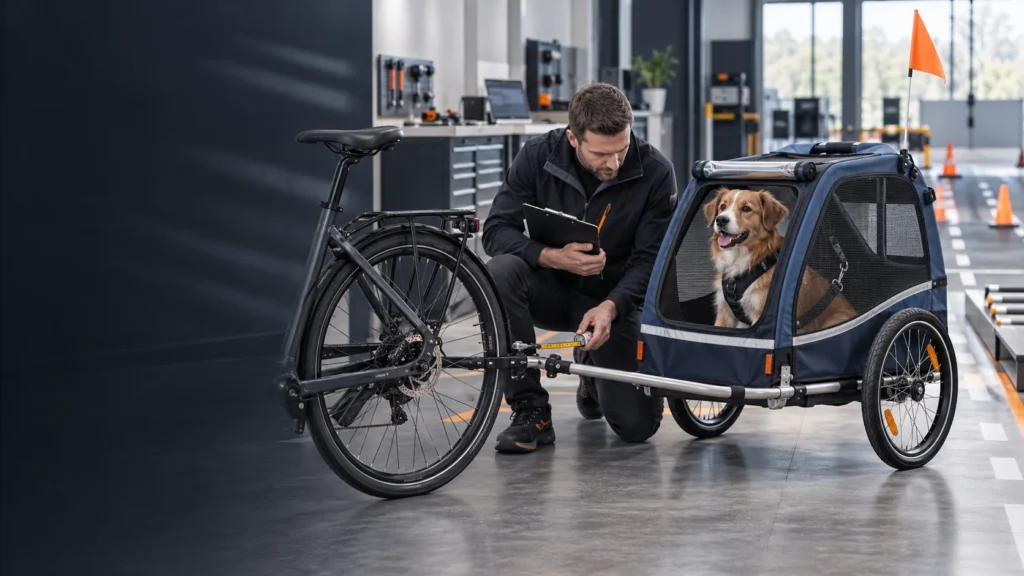
A pet bike trailer should never be evaluated only by its fabric color, folded size or wholesale price. It is a moving product connected to a bicycle, carrying a live animal close to roads, wheels and other traffic.
For importers, distributors and private-label pet brands, the main purchasing question is not simply whether a trailer looks attractive. It is whether the frame, hitch, wheels, cabin, restraint system and assembly instructions work together reliably under real riding conditions.
A defective connector can allow the trailer to separate from the bicycle. A weak axle can affect tracking and stability. An unsuitable internal leash can create entanglement or allow the pet to escape. Poor ventilation, inadequate visibility and unclear weight limits can also create avoidable risks.
This pet bike trailer safety checklist explains what buyers should review during supplier selection, sample approval, production and pre-shipment inspection.
Quick Pet Bike Trailer Safety Checklist
| Inspection area | Buyer should verify |
|---|---|
| Frame | Welds, tube strength, alignment and deformation |
| Hitch system | Coupler fit, locking pin, backup strap and articulation |
| Drawbar | Strength, connection points and clearance |
| Wheels | Axle retention, bearings, runout and tire condition |
| Stability | Tracking, turning, slope behaviour and tip resistance |
| Cabin | Pet containment, ventilation, floor support and entry closure |
| Restraint | Correct leash length, secure anchor and harness compatibility |
| Visibility | Reflective materials, flag and rear visibility |
| Weather protection | Rain cover, airflow and drainage |
| Convertible functions | Stroller wheel, handle, parking brake and mode locks |
| Labels | Weight limit, warnings, model and traceability |
| Instructions | Assembly, hitching, pet loading and maintenance |
| Packaging | Component protection, hardware control and carton strength |
| Batch inspection | Functional checks, workmanship and AQL sampling |
This checklist should be converted into measurable requirements for each model. Statements such as “strong frame” or “high-quality wheels” are not sufficient purchasing specifications.
1. Define the Intended Use Before Testing
The correct safety requirements depend on how the product will be marketed.
A basic dog bicycle trailer and a 2-in-1 dog bike trailer stroller do not have identical functions. A lightweight trailer for a small dog also faces different structural loads from a large dog bike trailer rated for 45 kg or 100 lbs.
The specification should define:
- Maximum permitted pet weight
- Maximum total load
- Recommended pet size
- Trailer-only or trailer-and-stroller use
- Intended road or surface conditions
- Compatible bicycle types
- Minimum wheel size of the towing bicycle
- Maximum recommended riding speed
- Prohibited uses
- Storage and maintenance conditions
If a model is marketed as an all-terrain dog bike trailer, the supplier should explain what “all-terrain” means. Large wheels and aggressive tire patterns alone do not prove that the trailer is suitable for rough surfaces.
The product claim must match the test plan.
2. Inspect the Frame and Chassis
The frame carries the pet, transfers towing forces and supports the cabin, wheels and hitch assembly.
Importers should check:
- Frame material and tube dimensions
- Tube-wall thickness where relevant
- Weld location and consistency
- Rivets, bolts and fasteners
- Frame symmetry
- Axle alignment
- Folding joints
- Locking mechanisms
- Corrosion protection
- Sharp edges and exposed tube ends
The sample should sit level on a flat surface. Wheels should not appear visibly misaligned, and the cabin should not lean to one side.
Inspect welded areas for cracks, incomplete welds, excessive grinding or burn-through. On folding models, check whether repeated folding creates movement around pivots and whether locks engage positively.
A foldable dog bike trailer may be convenient for consumers, but every folding joint introduces another potential wear point. Folding convenience must not compromise frame rigidity.
3. Treat the Hitch and Coupler as Critical Components
The hitch system is one of the most important parts of a pet bicycle trailer.
It usually includes:
- Bicycle-side coupler
- Drawbar or tow arm
- Locking pin
- Retaining clip
- Flexible or articulated joint
- Backup safety strap
- Trailer-side attachment
Check whether the coupler fits the intended bicycle configuration without interfering with the frame, axle, brake or derailleur.
The connection should remain secure while the bicycle:
- Travels straight
- Turns tightly
- Leans
- Passes over uneven surfaces
- Stops suddenly
- Is moved backward
- Falls on its side
A backup strap should be independently attached and should not depend on the same single failure point as the primary coupler.
Historical bicycle-trailer recalls demonstrate why this area deserves critical-defect status. The U.S. Consumer Product Safety Commission has documented trailer recalls involving hitch-arm bracket fatigue, U-joint problems and connection failures that could allow a trailer to separate or create a crash hazard. genui{“citation”:{“refs”:[“turn3search18″,”turn3search29”]}}
For production inspection, missing pins, incorrect fasteners, incomplete engagement or defective safety straps should not be treated as minor cosmetic problems.
4. Check the Drawbar and Connection Geometry
The drawbar must transfer towing loads without excessive flexing or contacting the bicycle wheel.
Verify:
- Drawbar material and thickness
- Fastener grade and quantity
- Trailer-side reinforcement
- Folding or removable-arm locking
- Ground clearance
- Tire clearance
- Turning clearance
- Resistance to twisting
- Absence of sharp edges
Inspect whether the drawbar remains secure after repeated assembly and removal.
A removable tow arm can reduce carton size, but incorrect assembly becomes more likely. The design should make the correct position obvious, and the instructions should show every locking step clearly.
5. Test Wheels, Axles and Retention Systems
Wheel problems can cause poor tracking, vibration, instability or complete wheel separation.
Buyers should check:
- Wheel diameter
- Tire material
- Bearing condition
- Axle straightness
- Wheel runout
- Axle-lock engagement
- Retaining buttons or pins
- Hub movement
- Tire pressure requirements
- Replacement-part availability
Quick-release wheels must lock securely and provide clear confirmation that the axle is engaged.
Pull each installed wheel outward using an agreed inspection force. Rotate it and check for wobble, noise or excessive friction.
After road testing, inspect the axle, hub and retention mechanism again. A system that looks acceptable before testing may loosen after vibration and cornering.
6. Evaluate Tracking and Stability
A pet trailer should follow the bicycle predictably without excessive weaving, bouncing or pulling to one side.
Test with the load distributed in realistic positions, not only centered perfectly in the cabin.
The trial should include:
- Straight-line riding
- Left and right turns
- Tight turns
- Controlled braking
- Uneven surfaces
- Low obstacles
- Gentle slopes
- Starting and stopping
- Bicycle lean and parking situations
A heavier dog may move inside the cabin and change the center of gravity. The test plan should therefore consider both a fixed test load and realistic load movement.
Check wheelbase, cabin height and floor position. A high floor combined with a narrow track can increase rollover risk.
Do not present a trailer as “tip-proof.” Instead, establish intended operating conditions, measurable stability requirements and clear user warnings.
7. Inspect the Cabin and Pet-Containment System
The cabin must contain the animal without creating avoidable trapping, escape or contact hazards.
Review:
- Entry opening
- Zippers or no-zip closures
- Mesh strength
- Seam quality
- Floor-board support
- Sidewall rigidity
- Internal clearance
- Wheel separation
- Canopy attachment
- Rain cover
- Drainage
- Pet visibility
The pet should not be able to reach the wheels or moving parts from inside the cabin.
Zippers should remain closed during vibration and movement. If the design uses buckles or no-zip latches, test whether a pet can push the opening outward.
Mesh panels should provide ventilation while resisting clawing and normal pet movement. Examine the stitching around mesh corners, because stress often concentrates at these transitions.
The floor should support the specified load without excessive bending. A removable cushion should not hide an unsupported or unstable base.
8. Review the Internal Leash and Anchor Points
Many current dog bike trailer products promote an internal safety leash as a key feature. However, simply including a leash does not guarantee safe restraint.
Check:
- Anchor-point location
- Anchor strength
- Leash length
- Adjustment range
- Clip operation
- Corrosion resistance
- Compatibility with a pet harness
- Entanglement risk
- Quantity of leashes for multi-pet use
The leash should normally be attached to a suitable harness rather than relied upon as a neck restraint.
An excessively long leash may allow the pet to jump partly out of the cabin or reach the wheel area. An excessively short leash may restrict normal positioning or increase strain during sudden movement.
For double-pet trailers, evaluate whether two leashes can cross, tangle or pull the animals together.
9. Confirm Ventilation and Weather Protection
A fully covered cabin may protect against rain but reduce airflow. A highly ventilated mesh cabin may offer little protection against wind, dust or road spray.
The design should balance:
- Front ventilation
- Side ventilation
- Rear airflow
- Rain protection
- Sun protection
- Splash resistance
- Drainage
- Seasonal use
Check whether a rain cover can be partially opened and whether ventilation remains available when it is closed.
Product instructions should warn users against leaving pets unattended inside the trailer and should address hot-weather use. Avoid unsupported claims such as “completely waterproof” unless the complete product and seams have been evaluated accordingly.
10. Check Visibility Features
Pet bike trailers sit lower than bicycles and may be less visible to drivers.
Visibility features may include:
- High-visibility fabric panels
- Reflective strips
- Reflective wheel details
- Rear reflectors
- Side reflectors
- Safety flag
- Light-mounting points
Inspect the position, attachment and durability of these components.
A bright fabric color is not a substitute for a complete visibility assessment. Buyers should determine the destination market’s applicable rules and intended road-use conditions.
If a safety flag is included, confirm the pole sections connect securely and that the flag does not detach during vibration.
11. Inspect Brakes and Stroller Conversion Components
For a 2-in-1 pet bike trailer and stroller, inspect both operating modes independently.
Stroller-mode checks should cover:
- Front-wheel attachment
- Front-wheel lock
- Handle attachment
- Handle-height adjustment
- Parking brake
- Wheel swivel
- Straight tracking
- Mode-conversion locks
- Storage of unused components
The user should not be able to enter trailer mode while leaving the stroller wheel in an unsafe position.
A parking brake should hold the loaded product on the specified test slope. It should not be described as a riding brake unless it is specifically designed and tested for that function.
Conversion steps must be clearly illustrated in the instruction manual.
12. Verify Load Claims Through Testing
A supplier’s maximum-weight claim should not be accepted without supporting information.
Ask:
- How was the load limit determined?
- Was testing static or dynamic?
- What safety factor was used?
- Was the complete trailer tested?
- Were the hitch, drawbar, axles and floor evaluated?
- How many cycles were performed?
- Was the trailer tested after environmental conditioning?
- Is a test record available?
Static loading is useful but does not reproduce vibration, cornering, braking or repeated impact.
Develop a model-specific test plan that may include:
- Static floor loading
- Frame deformation checks
- Hitch pull testing
- Drawbar fatigue
- Wheel-retention checks
- Folding-cycle testing
- Brake-holding testing
- Loaded road simulation
- Tip or stability evaluation
- Seam and anchor-point strength
The claimed capacity should be based on the weakest relevant component, not only on the strength of the frame.
13. Review Materials and Workmanship
A typical pet bike trailer may combine steel or aluminium tubes, plastic connectors, Oxford fabric, mesh, rubber or plastic tires, foam, coatings and printed materials.
Inspect for:
- Sharp edges
- Burrs
- Pinch points
- Exposed fastener ends
- Loose threads
- Odour
- Color transfer
- Coating damage
- Rust
- Fabric tears
- Incorrect component substitutions
Material and chemical requirements depend on the destination market. Buyers should confirm applicable restrictions with a qualified laboratory instead of relying on a generic statement such as “all materials are safe.”
For EU sales, importers also need to consider the General Product Safety Regulation. It requires economic operators to address product safety, traceability, instructions and relevant warnings. A company placing the product on the market under its own name or trademark may assume manufacturer responsibilities under the regulation. genui{“citation”:{“refs”:[“turn3search0″,”turn3search21″,”turn3search39”]}}
14. Confirm the Applicable Standard and Test Scope
EN 15918 specifies safety requirements and test methods for certain two-track cycle trailers and their connecting devices. Its scope and exclusions must be reviewed against the exact pet trailer design and intended use. genui{“citation”:{“refs”:[“turn3search5″,”turn3search13”]}}
Do not automatically advertise every pet trailer as “EN 15918 certified.”
Before making a compliance claim:
- Confirm the applicable market.
- Confirm that the model falls within the standard’s scope.
- Define the complete test configuration.
- Use a qualified laboratory.
- Check the report’s model, photographs and components.
- Ensure production matches the tested sample.
A test report for a similar trailer or an earlier frame version may not cover the product being ordered.
In markets without a dedicated mandatory pet trailer standard, general product-safety obligations still apply. The importer remains responsible for assessing foreseeable risks and maintaining appropriate technical and traceability documentation.
15. Check Labels and Instructions
The product and packaging should identify the correct model and important operating limitations.
Consider including:
- Model number
- Batch or production code
- Maximum pet weight
- Maximum total load
- Country of origin
- Manufacturer information
- Importer or responsible-party information
- Hitch warnings
- Speed recommendation
- Harness-use instruction
- Assembly warnings
- Prohibited passenger use
- Maintenance schedule
- Tire-pressure information where applicable
The manual should clearly explain:
- Bicycle compatibility
- Coupler installation
- Backup-strap installation
- Wheel installation
- Pet loading
- Harness connection
- Trailer-to-stroller conversion
- Pre-ride inspection
- Cleaning and maintenance
- Replacement of worn components
EU importers should note that GPSR safety information must be provided in a language consumers can easily understand, as determined by the Member State where the product is sold. genui{“citation”:{“ref”:”turn3search23″}}
16. Include Packaging in the Safety Inspection
Transport damage can turn a compliant sample into unsafe inventory.
Check:
- Protection around axles and frame tubes
- Separation of metal components
- Hardware bags
- Component count
- Carton strength
- Internal movement
- Moisture protection
- Barcode and carton marks
- Manual placement
- Assembly-tool inclusion
A protruding axle can puncture the carton or damage another product. Loose fasteners may be lost before assembly.
Conduct packaging-drop and vibration evaluations appropriate to the distribution method, especially for e-commerce products shipped individually to consumers.
17. Build a Pre-Shipment Inspection Plan
A pet bike trailer pre-shipment inspection should combine visual, dimensional and functional checks.
Critical items may include:
- Hitch integrity
- Wheel retention
- Frame cracks
- Missing safety pins
- Missing backup straps
- Brake failure
- Incorrect load labels
- Sharp hazardous edges
Major items may include:
- Poor tracking
- Defective zippers
- Loose folding locks
- Incorrect components
- Damaged wheels
- Missing instructions
- Weak packaging
Minor defects may include limited cosmetic marks that do not affect function, safety or saleability.
ISO 2859-1:2026 provides acceptance-sampling plans indexed by AQL for lot-by-lot inspection. The buyer must still define the inspection level, defect categories and acceptance limits suitable for the product. genui{“citation”:{“refs”:[“turn3search16″,”turn3search25”]}}
Do not rely on AQL sampling alone for safety-critical components. Some critical items may require 100% verification during production or final assembly.
Questions to Ask a Pet Bike Trailer Manufacturer
Before approving an OEM pet bike trailer project, ask:
- Which trailer models are currently in regular production?
- What is the verified maximum load?
- How is the hitch system tested?
- Is a secondary safety strap included?
- Which bicycle axle types are compatible?
- What wheel-retention system is used?
- Which frame and drawbar fatigue tests are performed?
- Can you provide the complete component specification?
- Which safety standard was used, and is the model within its scope?
- Can the test report be matched to the quoted product?
- What changes require retesting?
- Are replacement hitches, wheels and pins available?
- What is the MOQ for private-label packaging?
- Can an independent pre-shipment inspection be arranged?
- How are safety-related complaints and corrective actions handled?
A professional supplier should explain limitations and compatibility instead of simply agreeing that a trailer fits every bicycle and market.
How Pet Mobility Source Supports Pet Trailer Projects
Pet Mobility Source works with pet brands, importers, distributors and wholesalers that need coordinated sourcing rather than a single unverified catalog quotation.
We are a China-based supply-chain and project-management partner, not a claim of one factory producing every pet mobility category.
Our support can include:
- Product requirement analysis
- Supplier and production-platform comparison
- OEM and private-label feasibility review
- Sample coordination
- Hitch and component specification alignment
- Packaging and instruction review
- Production follow-up
- Quality inspection coordination
- Test-document review
- Spare-parts planning
- Mixed-product consolidation
- Export and shipping coordination
For buyers purchasing pet bike trailers together with pet strollers, carriers, car seats, ramps or mobility products, we can coordinate compatible suppliers and consolidate approved products into one export shipment.
Final Buyer Recommendation
Pet bike trailer safety depends on the complete system.
A strong fabric cabin cannot compensate for a weak hitch. A reinforced frame cannot compensate for an insecure wheel. A high load claim has little value without stable tracking, reliable restraint and appropriate testing.
Before placing a wholesale order:
- Define the intended use.
- Approve a measurable specification.
- Verify the supplier and production location.
- Test the complete sample.
- Confirm applicable market requirements.
- Inspect production before shipment.
- Maintain traceability and spare parts.
If you are developing a foldable dog bike trailer, large dog bike trailer, all-terrain pet trailer or 2-in-1 trailer-and-stroller platform, send Pet Mobility Source your target market, required capacity, order quantity and customization plan.