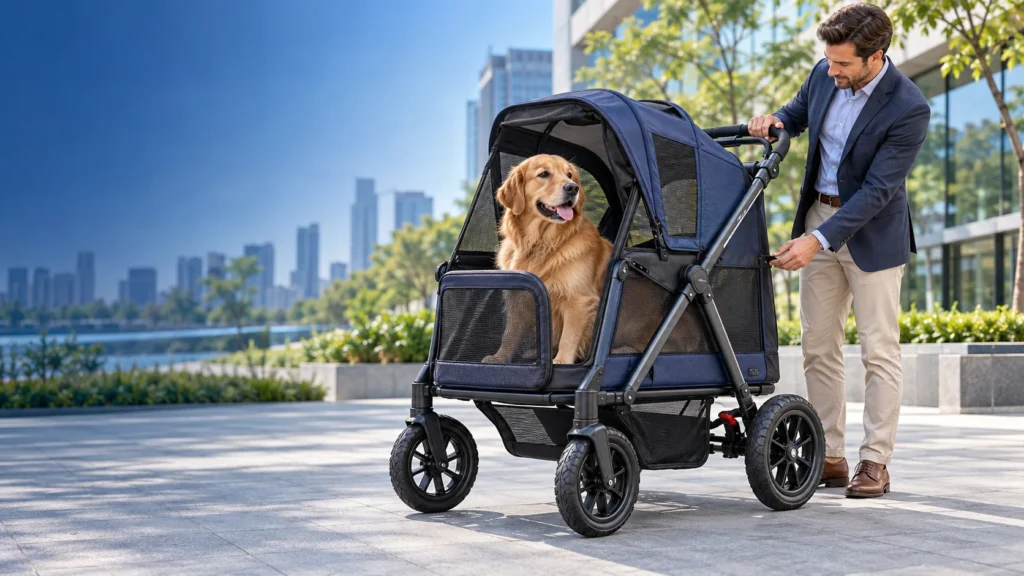
Choosing a large dog stroller is not simply a matter of finding the model with the highest printed weight capacity. For distributors, importers and private-label brands, the real purchasing decision involves cabin dimensions, frame rigidity, wheel performance, entry height, braking, folding size, packaging volume, production consistency and after-sales risk.
A stroller advertised for a 100 lb dog may still be unsuitable if the cabin is too short for the animal to sit naturally. A spacious stroller may feel unstable if its wheelbase is narrow. A low FOB price can also become expensive after oversized cartons, replacement wheels and customer returns are included.
This guide explains how professional buyers should evaluate a large dog stroller wholesale project before comparing quotations or approving mass production.
Why Demand for Large Dog Strollers Is Growing
Large pet strollers serve a different market from lightweight cat and small-dog strollers. Their typical users include:
- senior dogs with reduced walking endurance;
- dogs recovering from surgery or injury;
- pets with arthritis, hip problems or limited mobility;
- two small or medium dogs sharing one cabin;
- pet owners attending outdoor events or travelling in crowded areas;
- customers who need a pet wagon for parks, camping or longer walks.
Recent product listings and sourcing searches increasingly use phrases such as extra large dog stroller, heavy duty dog stroller, dog stroller 100 lbs, all terrain dog stroller and dog stroller for 2 dogs. These phrases reveal the features buyers now expect: more usable space, stronger frames, larger wheels, easier entry and dependable folding.
For distributors, this creates an attractive higher-value category. However, it also creates greater product-liability and return risk than an entry-level stroller. A larger animal produces higher forces during turning, braking and curb crossing, so construction quality matters more than a headline load number.
1. Start With the Pet Profile, Not the Stroller
Before asking a supplier for its best-selling model, define the intended pet and usage scenario.
Ask four questions:
- Is the stroller for one large dog or two medium dogs?
- Is the main user an elderly or mobility-impaired pet?
- Will the stroller be used mainly on city sidewalks or mixed outdoor surfaces?
- Does the customer need compact car storage or prioritize cabin size?
A product for one senior Labrador requires a different cabin shape from a model intended for two small dogs. Similarly, a stroller for shopping malls does not need the same wheels as an all-terrain model used on gravel paths.
Create a written target-use specification before requesting prices. This prevents suppliers from quoting visually similar products that serve different markets.
2. Evaluate Cabin Dimensions and Usable Space
Weight capacity is important, but cabin dimensions often determine whether a large pet can actually use the product.
Request the internal usable measurements:
- cabin floor length;
- internal width;
- usable height with the canopy closed;
- entrance width and height;
- distance between internal frame members;
- cushion thickness;
- number and position of safety tethers.
Do not rely only on overall product dimensions. Handles, wheels, exterior fabric and frame tubes can make a stroller look large without increasing the space available to the animal.
For a dog stroller for 2 dogs, check both the combined weight and usable floor area. Two pets need room to change position without standing on each other. Two independent safety tethers are preferable when the model is marketed for multiple pets.
Distributors should add a cabin-size diagram to the product page. This reduces size-related returns and gives customers more useful information than breed recommendations alone.
3. Verify the Load Capacity Claim
Labels such as “75 lb,” “100 lb” or “150 lb” are marketing claims unless supported by a defined test method and production controls.
Ask the supplier:
- How was the maximum load determined?
- Was the test static or dynamic?
- How long was the stroller loaded?
- Was it tested while folded, pushed, turned or moved over obstacles?
- Which components showed the first signs of deformation?
- Is the test based on a sample or routine production inspection?
Static loading alone does not reproduce the forces created when a stroller crosses a curb, turns suddenly or travels over an uneven path. Buyers should agree on an appropriate safety margin and dynamic-use protocol based on the intended claim.
Pay particular attention to frame joints, folding hinges, wheel axles, cabin support points and handle connections. These areas usually experience more stress than the center of the cabin floor.
4. Choose Between Three-Wheel and Four-Wheel Designs
Both configurations can work well, but they serve different selling points.
| Structure | Main strengths | Main considerations | Best suited for |
|---|---|---|---|
| Three-wheel | Responsive steering, sporty appearance, larger front wheel possible | Requires careful stability and front-wheel testing | Parks, mixed surfaces, jogger-style positioning |
| Four-wheel | Stable platform, familiar operation, easier urban positioning | Turning radius and wheel alignment must be controlled | Sidewalks, shopping, senior pets |
| Wagon-style four-wheel | Large low cabin, easy entry, high usable space | Larger carton and folded volume | Large dogs and multi-pet use |
A 3 wheel dog stroller should be evaluated for lateral stability and front-wheel behavior. A 4 wheel dog stroller should be checked for alignment, rolling resistance and whether all wheels contact the ground consistently.
If the product is marketed as a jogging stroller, normal walking tests are insufficient. High-speed use requires stronger validation of tracking, wheel retention, braking, handle rigidity and stability. Avoid professional jogging claims unless the design and testing support them.
5. Compare Wheel Materials and Suspension
Wheel design strongly affects perceived quality.
Common options include:
- EVA wheels: light, economical and puncture-free, but less comfortable on rough surfaces;
- PU or rubber-coated wheels: improved grip and rolling feel, with moderate cost;
- Pneumatic tires: better cushioning for outdoor use, but heavier and vulnerable to punctures;
- Solid rubber wheels: durable and stable, but may increase weight and carton cost.
For an all terrain dog stroller, wheel diameter is as important as material. Larger wheels generally cross gaps and uneven surfaces more easily, but they also increase folded dimensions and shipping volume.
Check suspension travel, axle play, wheel wobble, bearing noise and front-wheel shimmy. A stroller may roll smoothly when empty but behave differently under a large moving pet.
Replacement wheels should be available as spare parts. For distributors, wheel assemblies are among the most useful after-sales components to stock.
6. Inspect Entry Height, Access and Cabin Security
Large senior dogs should not be expected to jump into a high cabin. A low entry dog stroller or dual-entry design can be a stronger selling point than decorative features.
Evaluate:
- rear or front entrance height;
- opening size;
- zipper quality and direction;
- whether the door remains open during loading;
- floor rigidity;
- internal tether attachment points;
- canopy locking method;
- mesh strength and scratch resistance.
A dual-entry cabin allows a mobility-impaired dog to enter from one side and exit from the other without turning around. This is particularly valuable for long-bodied or older pets.
Safety tethers should attach to a structural or reinforced point, not only to thin fabric. They should be used with a harness rather than attached directly to a collar.
7. Check the Frame, Handle and Folding System
Large dog strollers require more than thicker-looking tubes. Frame material, tube dimensions, joint design, welding, rivets, fasteners and plastic connectors all affect durability.
During sample evaluation, check:
- handle movement under load;
- frame twisting during turns;
- folding-lock engagement;
- accidental-folding protection;
- hinge clearance and pinch points;
- fastener loosening after repeated use;
- cabin sagging;
- corrosion protection;
- handle-height adjustment.
A one-click fold can improve consumer appeal, but it must remain secure under load. Repeated folding tests should be conducted on a fully assembled sample rather than only on the bare frame.
Adjustable handles are useful for larger strollers because users need leverage when pushing a heavier pet. Ask for the minimum and maximum handle heights, not simply whether the handle is “adjustable.”
8. Treat Braking as a Critical Function
For a heavy stroller, the parking brake is not a minor accessory.
Check whether the brake:
- locks both rear wheels;
- is easy to operate while wearing normal shoes;
- remains engaged on an agreed incline;
- releases without excessive force;
- avoids contact with the user’s foot during walking;
- continues to work after durability cycling;
- can tolerate dirt and normal outdoor use.
Marketing teams should distinguish between a parking brake and a dynamic hand brake. Do not advertise “advanced braking” unless the actual system supports the claim.
9. Calculate Folded Size and Landed Cost
Large dog strollers are highly sensitive to cubic volume. A model that costs five dollars less at the factory may be more expensive after freight if its carton is substantially larger.
Request:
- product size;
- folded size;
- individual carton size;
- net and gross weight;
- units per 20GP, 40GP and 40HQ;
- pallet quantity if pallets are required;
- loading photographs from comparable orders.
Calculate landed cost per unit, not only FOB price. Include ocean or truck freight, duty, port charges, warehouse handling, delivery surcharges, inspection, spare parts and expected returns.
For e-commerce distribution, ask whether the carton is designed for parcel networks. Large products may require stronger corners, internal wheel protection and better fixation than products shipped only by pallet to a distributor.
Consider carton drop and vibration testing appropriate to the intended distribution channel. Damage to wheel axles, cup holders and plastic connectors often comes from packaging rather than manufacturing.
10. Build a Large Dog Stroller QC Checklist
A pre-shipment inspection should go beyond appearance and carton count.
Recommended checkpoints include frame dimensions and finish; fabric, mesh, fasteners and wheel specifications; opening, folding and locking functions; wheel retention and straight-line rolling; steering, brake, canopy, zipper and tether operation; agreed static and dynamic load checks; repeated folding; brake holding; and post-test inspection of handles and joints.
Packaging inspection should verify accessories, manuals, logos, labels, barcode scans, carton markings, internal protection, dimensions, weight and final quantity.
The inspection standard, sample size and acceptance limits should be agreed before production. “QC passed” has little value unless both parties understand what was checked.
11. Review Market Requirements Before Finalizing Labels
Pet strollers are generally treated differently from baby strollers, but they still fall under applicable general consumer-product rules in the destination market.
Requirements may involve:
- material and chemical restrictions;
- textile or product labeling;
- importer and manufacturer identification;
- warnings and instructions;
- packaging and recycling requirements;
- traceability information;
- substantiation for safety and performance claims.
European buyers should review current General Product Safety Regulation obligations, including traceability and responsible economic-operator information. US buyers should consider applicable federal and state consumer-product requirements, as well as chemical or warning obligations relevant to the materials used.
Requirements vary by market and product construction. The importer should confirm the final compliance plan with a qualified laboratory or compliance professional before mass production.
12. Decide What to Customize
An OEM project does not need dozens of changes. The most commercially useful options are often:
- two or three exclusive fabric colors;
- embroidered, printed or sewn-on logo;
- branded cushion or liner;
- customized warning and care labels;
- market-specific instruction manual;
- retail or mail-order carton artwork;
- barcode, FNSKU or warehouse labels;
- rain cover, cup holder or organizer bundle;
- replacement wheel and hardware kit.
Before approving custom colors, ask about fabric MOQ and color variation between production lots. Before approving a logo, test its adhesion, abrasion resistance or embroidery quality on the actual fabric.
Private-label buyers should keep spare parts and after-sales documentation in the project scope. A successful private label pet stroller program includes a replacement-parts plan, not only branded packaging.
13. Understand MOQ and Pricing
MOQ depends on more than frame production. It may be driven by custom fabric, logo process, packaging printing or component color.
When comparing quotations, request a breakdown covering:
- standard product MOQ;
- custom-color MOQ;
- logo setup and unit cost;
- packaging setup and printing cost;
- sample cost;
- testing cost;
- spare-parts allowance;
- production lead time;
- carton dimensions and container loading.
A supplier offering a low MOQ may use stock materials, while a fully customized order requires a higher quantity. For initial market testing, a standard frame with custom logo, manual and carton may offer a better balance than changing every component.
Common Purchasing Mistakes
Distributors frequently create unnecessary risk by:
- selecting only by claimed weight capacity;
- using breed names instead of cabin measurements;
- confusing a large cabin with a strong frame;
- ignoring folded dimensions and freight cost;
- accepting “all terrain” without wheel and durability testing;
- overlooking low-entry access for senior dogs;
- approving mass production without a sealed sample;
- failing to order spare wheels and wear parts;
- making unsupported jogging or automotive-safety claims;
- changing too many components in the first order.
The best initial model is not always the product with the most features. It is the model whose target customer, specification, quality plan and landed cost are clearly understood.
How Pet Mobility Source Supports Distributors
Pet Mobility Source works as a sourcing and project-management partner for pet brands, importers, distributors and wholesalers. We coordinate the supply chain rather than representing every product as coming from one self-owned factory.
Our support can include:
- product and supplier screening;
- specification and quotation comparison;
- OEM color, logo and packaging coordination;
- sample review and pre-production confirmation;
- production follow-up;
- product-specific quality inspection;
- packaging and carton verification;
- spare-parts planning;
- mixed-product consolidation;
- export documentation and shipment coordination.
For large dog stroller projects, we focus on the details that directly affect distributor risk: cabin fit, load validation, frame and wheel consistency, folding reliability, packaging strength, replacement parts and accurate shipment documentation.
Frequently Asked Questions
What size stroller is suitable for a large dog?
Select by the dog’s weight, body length, seated height and turning space—not weight alone. Compare these measurements with the stroller’s internal cabin dimensions and entrance size.
Is a 100 lb dog stroller automatically heavy duty?
No. A 100 lb label should be supported by a defined load and durability test. Frame joints, axles, folding locks, brakes and cabin supports must also be evaluated.
Is a three-wheel or four-wheel stroller better for large dogs?
Three-wheel designs can offer responsive steering and an outdoor appearance. Four-wheel and wagon-style designs often provide a stable platform and larger usable floor area. The correct choice depends on the target use and validated stability.
What features matter most for senior dogs?
A low entrance, rigid floor, stable frame, good ventilation, secure tether points, smooth rolling wheels and easy braking are usually more important than decorative accessories.
Can large dog strollers be customized for private labels?
Yes. Common options include fabric colors, logos, cushions, labels, manuals, cartons, barcodes and accessory bundles. MOQ depends on the degree of customization.
What spare parts should distributors stock?
Recommended items include front and rear wheel assemblies, brake components, locking parts, safety tethers, cushions, canopies and frequently used fasteners.
Request a Large Dog Stroller Sourcing Proposal
If you are developing a large dog stroller wholesale range, send us your target market, expected load class, preferred cabin size, wheel requirements, estimated quantity, branding needs and delivery destination.
Pet Mobility Source can help compare suitable platforms, coordinate samples, clarify OEM options, establish a product-specific QC checklist and calculate a more realistic export and packaging plan.
Request a wholesale quotation or start your OEM pet stroller project.