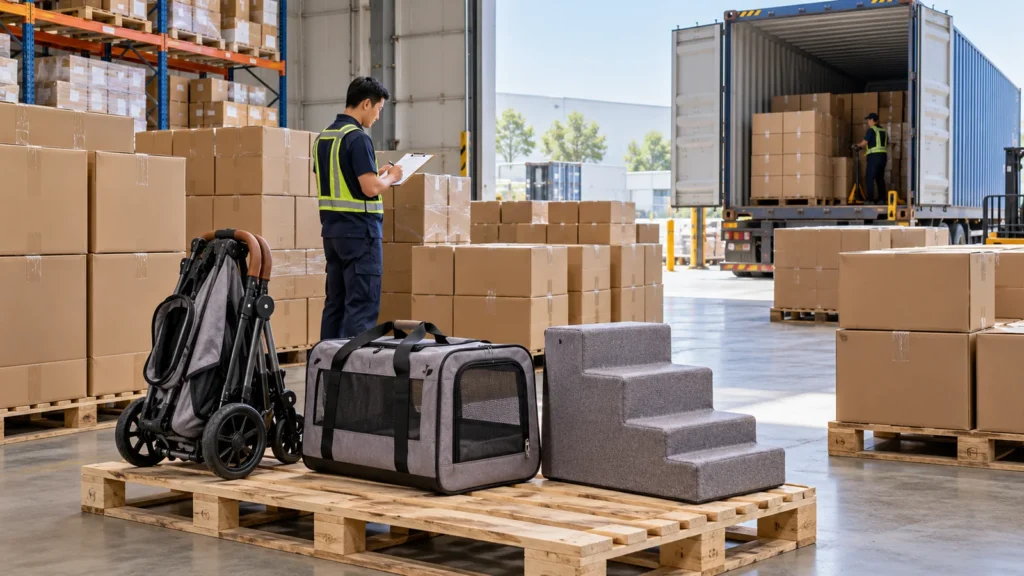
Buying pet products from several Chinese suppliers can help importers build a broader assortment. One supplier may offer suitable pet strollers, another may specialize in carriers, and a third may provide ramps or travel accessories.
The challenge is coordinating these orders. Different production schedules, packaging formats and inspection requirements can turn a straightforward purchasing plan into several disconnected shipments.
Pet product order consolidation brings compatible orders together for a coordinated shipment. Done well, it can simplify receiving and improve freight efficiency. However, the result depends on more than collecting cartons at one warehouse.
This guide explains how to consolidate orders from multiple suppliers in China, manage the main decision points and prepare a clear brief for your sourcing and logistics partners.
What Is Pet Product Order Consolidation?
Buyer consolidation means coordinating goods from multiple suppliers for the same buyer and combining suitable cargo into a planned shipment.
It may involve domestic collection, warehouse receiving, quantity reconciliation, inspection coordination, packaging adjustments and export preparation. The exact scope should be agreed before goods begin moving.
This differs from carrier-level LCL consolidation, where a logistics provider combines cargo from different shippers in a shared container.
Your own multi-supplier order may travel as either LCL or FCL. Gathering several factory orders does not automatically mean booking a full container.
The purchasing objective is to balance shipment cost, product readiness and inventory needs while preserving visibility at supplier and SKU level.
1. Decide Whether Consolidation Fits Your Order
Consolidation is worth evaluating when several suppliers serve the same destination and their cargo can be ready within a workable shipping window.
It may suit distributors building a mixed assortment, brands coordinating a launch or importers combining smaller replenishment orders.
However, combining everything is not always the best choice. A product needed urgently may justify separate shipment. Goods from widely separated regions may generate substantial domestic transport costs. One supplier’s order may already justify its own container.
Before choosing a route, compare:
- Supplier locations and collection costs.
- Cargo-ready dates.
- Carton dimensions and gross weights.
- Inspection status.
- Storage requirements.
- Destination and delivery deadline.
The aim is a commercially sensible shipment, not the maximum possible number of suppliers in one booking.
2. Build One Master Order List
Start with a shared order record rather than separate supplier messages.
For each line, record the purchase order, supplier, SKU, description, quantity, packaging configuration, expected carton count, dimensions, gross weight and cargo-ready date.
Include sample approval and inspection status. A product marked “finished” may still be waiting for artwork approval, inspection or export packaging.
Assign one person to maintain the master version. Record changes to quantities, carton sizes and dates so the sourcing team, warehouse and freight forwarder work from the same information.
A useful control table looks like this:
| Order detail | Why it matters |
|---|---|
| Supplier and purchase order | Connects received cargo to the correct order |
| SKU and approved quantity | Supports receiving and shortage checks |
| Carton count and packing configuration | Makes physical reconciliation possible |
| Dimensions and gross weight | Supports freight comparison and loading |
| Cargo-ready date | Identifies schedule conflicts |
| Inspection status | Separates ready goods from approved goods |
This record becomes the basis for collection instructions, receiving reports and shipment reconciliation.
3. Align Production Dates Before Booking Freight
When shipping pet products from multiple factories in China, one delayed supplier can affect the whole shipment.
Work backward from the required delivery window. Allow time for production completion, inspection, corrections, domestic transport, receiving and the forwarder’s cutoffs.
Keep these milestones separate. A factory’s completion date is not necessarily the date cargo can arrive at the consolidation point.
Agree what happens if a supplier misses the window. Options may include holding all orders, shipping approved cargo first or moving the delayed order to the next shipment.
Define who can approve that change and what cost information they need.
This avoids making an urgent decision after storage fees have started or a booking is at risk. Update the schedule when samples, artwork or materials change rather than relying on the original quotation date.
4. Choose a Consolidation Point Around the Cargo
The best receiving location depends on supplier geography, shipment routing and required handling.
Compare domestic transport routes and warehouse capabilities alongside the international freight quotation. A lower receiving fee may be offset by longer collection routes or extra handling.
Confirm the receiving address, booking procedure, operating hours and required carton markings before dispatch.
Ask the receiving operator to clarify:
- Receiving and handling charges.
- Storage terms and free-time allowances.
- Whether inspection or repacking can be arranged.
- How damaged or unidentified cargo is handled.
- Available loading and lifting equipment.
- Reporting procedures for discrepancies.
Check suitability for the actual products. Bulky strollers need different handling from soft carriers, and retail boxes may require protection from compression and moisture.
Confirm custody and responsibility at each handover.
5. Inspect Products Before They Become Shipping Cargo
Receiving checks and product inspection serve different purposes.
A warehouse can confirm that cartons arrived, count them and record visible damage. This does not establish that the products inside meet approved specifications.
For pet supplies quality inspection before shipment, define the inspection scope by product category.
For example, a stroller inspection may address dimensions, folding operation, wheel assembly, brakes, stitching and accessories. Carrier checks may focus on construction, zippers, dimensions and strap attachments. Ramp checks may include mechanisms, surface attachment and agreed load evidence.
Whenever practical, resolve production defects before goods leave the factory. Reworking products at a consolidation location may add cost and complicate responsibility.
Record accepted, rejected and pending quantities separately. Release decisions should refer to the approved specification and documented results, not simply to the need to catch a vessel.
6. Standardize Carton Identification and Receiving Records
Clear carton identification prevents confusion when similar products arrive from different factories.
Agree markings that connect each carton with the buyer, purchase order and SKU. Where practical, include units per carton and a carton sequence.
At receiving, reconcile the physical cargo with the supplier’s packing information. Record carton count, visible condition, arrival date and relevant photographs.
If cartons contain mixed SKUs, request an itemized breakdown that can be checked.
Do not place unidentified or disputed cartons into the final loading group until the discrepancy is resolved. Labeling mistakes become harder to investigate once the shipment has left the origin warehouse.
Keep an updated receiving summary showing what has arrived, what remains outstanding and what has been released for shipment.
This also gives the buyer a clear basis for supplier follow-up.
7. Review Packaging and Product Compatibility
A mixed container pet supplies from China project should be planned around physical compatibility as well as product variety.
Confirm carton strength, stacking restrictions, product orientation and any protection required during handling.
Heavy cartons should not be positioned where they can crush lighter retail packaging. Folding products need suitable protection around moving parts and exposed finishes.
For foam products, assess any proposed compressed packing method against recovery and appearance requirements. For private-label products, verify the approved retail artwork and labels before final release.
Do not change packaging solely to reduce volume without evaluating the consequences.
If the order includes battery-powered or other products with special transport requirements, disclose them to the forwarder before booking and obtain confirmation of the applicable handling route.
Consolidation should preserve the condition and identity of each product group.
8. Compare LCL and FCL for the Combined Order
LCL uses part of a shared container, while FCL reserves a container for the booked shipment. Both can be used after collecting orders from several suppliers.
The decision should consider the cargo, route, timing and complete charges. Maersk also advises that the relative cost of LCL and FCL depends on the shipment rather than a universal rule. LCL and FCL cost guidance
| Decision factor | LCL | FCL |
|---|---|---|
| Space arrangement | Shared container capacity | Container reserved for the shipment |
| Cost comparison | Check chargeable volume or weight and minimums | Check container rate and related charges |
| Handling | Includes consolidation and separation processes | Can reduce cargo handovers, depending on routing |
| Planning priority | Packaging, destination fees and service schedule | Loading plan, container choice and utilization |
Request comparable quotations with the same destination and service scope.
Do not select FCL simply because several suppliers are involved, or LCL simply because the container would not be completely full.
9. Calculate the Full Cost of Consolidation
Compare the total cost of separate shipments with the total cost of the proposed consolidated route.
Include supplier collection, domestic transport, receiving, storage, inspection, repacking, loading, documentation, international freight and relevant destination services.
Confirm whether charges are per order, carton, pallet, shipment or storage period. Identify excluded services and the circumstances that trigger additional fees.
Use an illustrative calculation to test the method. Suppose separate shipments would cost $4,800 in total logistics charges. A consolidated route is quoted at $3,600, with another $700 for collection and handling.
The estimated saving would be $500 before any other costs. These are hypothetical figures, not freight rates or a service quotation.
Allocate shared costs sensibly across SKUs. A bulky stroller and a compact carrier should not automatically receive the same freight allocation per unit.
10. Keep Export Documents Consistent With the Cargo
Consolidating physical goods does not automatically combine supplier invoices or remove product-level documentation.
Agree the exporter, consignee, invoicing arrangement and transport-document requirements with the parties handling the shipment.
Maintain enough SKU-level detail to connect the shipped goods with quantities, descriptions, values and supporting records.
Check the final packing information against the actual shipment after approved changes, rejected quantities or repacking.
Your forwarder and customs broker should confirm the document requirements for the destination and order structure. Combining goods into one container does not mean every item uses the same classification or import treatment.
Keep supplier records available for traceability, even where shipment-level documents are prepared through a coordinated export arrangement.
The objective is consistency between the physical cargo, commercial records and transport booking.
11. Define Responsibilities Before Cargo Moves
One coordinator can simplify communication, but each party still needs a clear role.
Document who approves specifications, releases inspection results, arranges collection, receives cargo, authorizes repacking and confirms the booking.
Also establish who decides whether to wait for a delayed supplier and who approves additional charges.
Keep commercial responsibility separate from operational coordination. A sourcing partner, supplier, warehouse and forwarder may each handle different parts of the process.
For private label pet products sourcing and consolidation, include responsibility for artwork, instructions and final packaging approval.
Create a short exception procedure for shortages, damage and late cargo. Require evidence and an agreed decision before proceeding.
Clear ownership helps prevent a familiar problem: every party believes another party has already checked the shipment.
12. Prepare a Reconciled Shipment Release
Before dispatch, bring the order list, receiving records and approved packing information together.
Confirm which goods are included, which are excluded and whether unresolved issues remain.
For FCL, agree a loading plan appropriate to carton dimensions, weight and stacking restrictions. Obtain the relevant loading record and shipment identifiers.
For LCL, confirm delivery into the nominated receiving process and retain the corresponding handover records.
Send the buyer a final shipment summary with quantities, packing information, inspection status and relevant documents.
After arrival, compare receiving results with the origin record. Track damage, shortages, delays and unexpected costs by cause.
These observations help improve packaging, supplier instructions and the next consolidation cycle rather than treating every shipment as a fresh project.
How Pet Mobility Source Supports Multi-Supplier Orders
Pet Mobility Source is a B2B pet travel and mobility supply-chain partner serving importers, distributors and brands.
Our service scope includes product selection, supplier coordination, OEM/ODM project management, quality-control coordination, compatible order consolidation and export support.
We help buyers connect the purchasing brief with sample approvals, production milestones and shipment preparation. This is particularly useful when a range includes several pet mobility categories rather than one factory’s products.
For your project, we review the product list, supplier locations, quantities, packaging and delivery requirements before proposing the coordination scope.
Inspection arrangements, consolidation locations, charges and shipment conditions should be confirmed in the project quotation. A clear plan helps buyers assess the commercial value before committing.
Frequently Asked Questions
Can I combine pet products from several factories into one shipment?
Yes, where the cargo, destination and schedule are compatible. Confirm receiving, inspection, documentation and transport arrangements before suppliers dispatch.
Does consolidation reduce each factory’s MOQ?
Not automatically. Factory minimums still depend on the product and customization. Consolidation concerns shipment coordination rather than changing manufacturing minimums.
Is a freight forwarder also responsible for product quality?
Only if a defined inspection service has been agreed. Carton receiving and freight handling do not establish conformity with the approved product specification.
What happens if one supplier is late?
Use the agreed exception procedure. Compare the cost of waiting with the consequences of a split shipment and obtain approval before changing the plan.
Can orders from my existing suppliers be included?
Send the supplier details, product list and order status for review. Confirm acceptance, coordination responsibilities and any additional requirements before cargo moves.
Plan Your Consolidated Pet Product Shipment
Successful consolidation connects purchasing, quality control and logistics through one documented plan.
Share your product list, supplier locations, quantities, estimated carton information and destination with Pet Mobility Source.
Request a project-based quotation to discuss product sourcing, inspection coordination, compatible order consolidation and export preparation for your next pet product order.