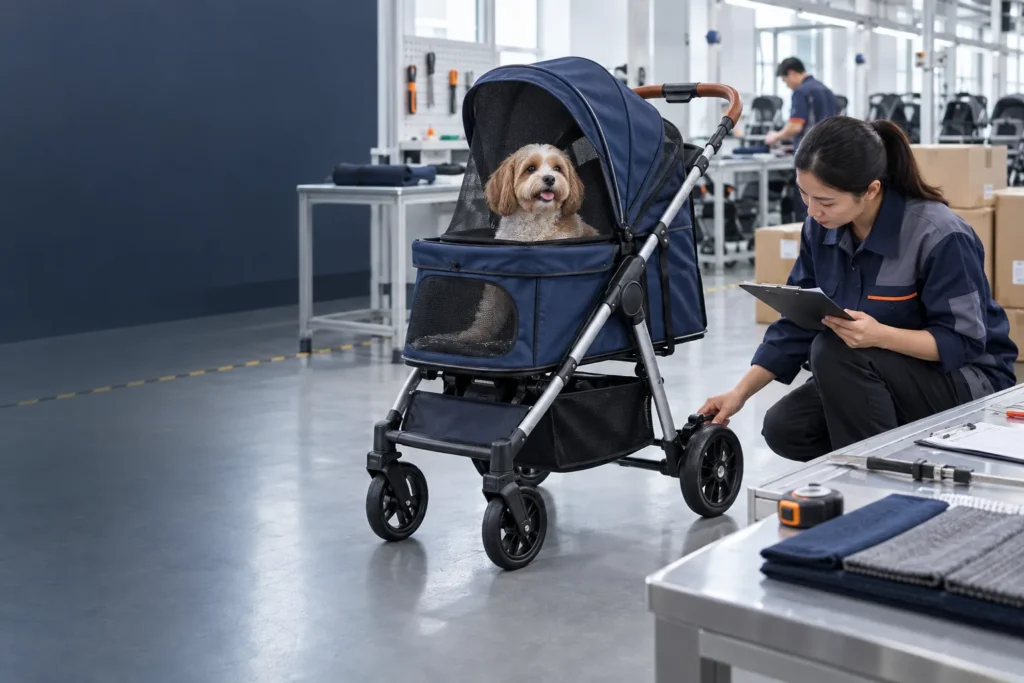
Choosing a pet stroller manufacturer is only the beginning of a successful sourcing project. Before a shipment leaves the factory, importers must confirm that the finished products meet the approved specifications, function consistently and can withstand normal transportation and consumer use.
A pet stroller may look acceptable in product photographs but still contain hidden quality problems. Loose folding locks, weak wheel connections, uneven frames, ineffective brakes, poorly stitched mesh and inaccurate weight-capacity claims can result in returns, negative reviews and damage to the importer’s brand.
For this reason, a professional pet stroller quality control process should cover raw materials, structural performance, workmanship, functionality, packaging and final random inspection.
This pet stroller quality control checklist explains 15 important checks that importers, wholesalers and private-label brands should complete before approving a shipment.
Why Pet Stroller Quality Control Matters
Pet strollers combine textile components, metal or plastic frames, wheels, brakes, folding mechanisms, fasteners and safety restraints. A quality problem in any one of these systems can affect the entire product.
For example:
- A stroller can pass a visual inspection but fail under its claimed load.
- A folding joint can work during sampling but become loose during mass production.
- Wheels can rotate smoothly indoors but wobble on uneven outdoor surfaces.
- A brake can hold an empty stroller but fail when the cabin is fully loaded.
- A poorly designed carton can allow the frame to become scratched or bent during shipping.
Importers should therefore avoid relying only on a factory’s general statement that a product has “passed QC.” The purchase specification and inspection checklist should define what is checked, how it is tested and what result is considered acceptable.
Pet strollers are not automatically subject to the same product standard as baby strollers. ASTM F833, for example, is a safety specification intended for carriages and strollers used to transport children. It should not be presented as a mandatory pet stroller certification unless the buyer’s market, product classification or contract specifically requires it.
The correct compliance plan must be determined according to the destination country, product design, materials, labeling and intended use.
1. Confirm the Approved Product Specification
The first step is to compare production units against the final approved specification sheet.
The inspection team should verify:
- Product model and SKU
- Frame material
- Tube diameter and wall thickness
- Product dimensions
- Folded dimensions
- Net and gross weight
- Maximum recommended pet weight
- Wheel size and material
- Fabric composition and color
- Mesh type
- Brake structure
- Safety tether quantity
- Accessories
- Logo position
- Packaging method
A verbal agreement with a pet stroller supplier is not enough. Every important requirement should appear in an approved specification sheet, purchase order, sample approval document or bill of materials.
At Pet Mobility Source, we consolidate the approved product specifications before production so the buyer, manufacturing partner and inspection team are working from the same version.
2. Inspect the Frame Structure and Alignment
The frame is the primary load-bearing system of a pet stroller.
Inspectors should place the assembled stroller on a flat surface and check whether all wheels contact the ground evenly. The frame should not lean to one side, twist or rock when stationary.
Important inspection points include:
- Bent or deformed tubes
- Uneven left and right frame geometry
- Poor welding
- Cracks around joints
- Sharp metal edges
- Incomplete coating
- Rust or oxidation
- Loose rivets and screws
- Incorrectly installed support bars
For aluminum pet strollers, the surface finish should be uniform and free from serious dents or scratches. For steel frames, coating coverage and corrosion resistance deserve particular attention.
Structural problems are difficult to solve after goods arrive in the destination market. Importers should therefore check frame alignment during production, not only during the final inspection.
3. Perform a Static Load Test
A pet stroller load test helps verify whether the frame, cabin base, wheels and joints can support the intended weight.
The test load and duration should be agreed before production. They should reflect the stated product capacity and include an appropriate safety margin determined by the buyer’s engineering requirements.
During the test, inspectors should monitor:
- Frame deformation
- Cabin-base sagging
- Wheel or axle movement
- Rivet loosening
- Handle deformation
- Noise from structural joints
- Folding-lock movement
- Brake performance under load
After removing the load, the stroller should remain functional and should not show permanent deformation that affects normal use.
For a large dog stroller, load testing is especially important because the heavier load increases stress on the frame, wheel mounts, brakes and cabin floor.
Importers should never publish a maximum load solely because a competing product uses the same claim. The stated capacity should be supported by product design and repeatable testing.
4. Check the Folding and Locking Mechanism
Foldable dog strollers are popular because they reduce storage space and international shipping volume. However, the folding mechanism is also one of the most important potential failure points.
The inspector should repeatedly open and fold the stroller and check:
- Whether the frame opens smoothly
- Whether the primary lock engages completely
- Whether a secondary safety lock is present when specified
- Whether the stroller can fold unexpectedly
- Whether release buttons require appropriate force
- Whether fingers can be trapped during normal operation
- Whether joints become loose after repeated cycling
- Whether the stroller remains stable after reopening
The number of test cycles should be stated in the quality plan. A simple “open once and close once” check is not sufficient for a meaningful durability evaluation.
For one-hand-folding pet stroller models, the release sequence must be intuitive but should not allow accidental folding during use.
5. Test the Braking System Under Load
A brake should not be inspected only by confirming that the pedal moves.
The stroller should be placed on the agreed test surface with the specified load. Once the brake is applied, the wheels should remain locked without excessive movement.
Check:
- Brake-pedal engagement
- Left and right brake synchronization
- Brake holding force
- Pedal deformation
- Accidental release
- Wheel rotation after locking
- Accessibility when the storage basket is loaded
If the design uses independent rear-wheel brakes, both should function consistently. If it uses a linked braking system, the connection between the left and right wheels must be secure.
Braking performance should also be reviewed after transportation simulation or durability testing because wheel and axle movement can affect brake alignment.
6. Inspect Wheels, Axles and Suspension
Wheel quality strongly influences the customer’s perception of a pet stroller.
Each wheel should rotate freely without obvious wobbling, rubbing or abnormal noise. Inspectors should verify that wheel-retention buttons, pins or locking clips engage fully.
The checklist should cover:
- Front-wheel swivel
- Directional locking
- Rear-wheel alignment
- Wheel retention
- Axle security
- Tire or EVA-wheel surface
- Bearing movement
- Suspension consistency
- Ground clearance
- Tracking during pushing
An all terrain dog stroller normally requires larger wheels, stronger wheel supports and more effective suspension than a lightweight urban model. Importers should test the product on surfaces that reflect its marketing claims.
If a stroller is promoted for jogging or rough outdoor use, the buyer should conduct a dedicated risk and performance assessment instead of relying on ordinary indoor rolling tests.
7. Evaluate Stability and Tipping Risk
A pet may move suddenly inside the cabin, so stroller stability should be evaluated under realistic loading conditions.
Inspectors should check front, rear and sideways stability with the agreed load distribution. The stroller should also be assessed when accessories or storage baskets are loaded.
Potential problems include:
- A high center of gravity
- A short wheelbase
- A narrow frame
- Heavy bags placed on the handle
- Uneven pet positioning
- Cabin extensions that change weight distribution
Warning labels should instruct users not to overload the handle or storage basket.
For double pet stroller and double-decker pet stroller designs, stability testing is particularly important because the total load and load position may differ significantly from a single-pet model.
8. Inspect Fabric, Mesh and Stitching
The textile cabin must contain the pet while providing ventilation and visibility.
Inspectors should look for:
- Fabric color differences
- Stains or oil marks
- Holes or damaged mesh
- Skipped stitches
- Broken threads
- Uneven seam allowance
- Weak zipper attachment
- Poorly secured hook-and-loop fasteners
- Sharp components beneath the fabric
- Incorrect care labels
Stress areas around the cabin base, entry opening, canopy, safety tether and frame attachment should receive additional inspection.
Fabric composition and chemical requirements should be agreed according to the destination market. For products entering the European Union, importers should review relevant REACH restrictions for substances used in fabrics, coatings, plastics and accessories.
A generic “eco-friendly material” claim is not a substitute for material documentation or laboratory testing.
9. Verify Zippers, Doors and No-Zip Closures
The pet should not be able to open the cabin accidentally.
For zipper models, check whether the zipper:
- Moves smoothly
- Is correctly sewn
- Resists separation
- Has suitable pullers
- Can be secured when required
- Does not catch the mesh or lining
For no-zip pet stroller models, test the locking latch repeatedly. It should engage clearly and should not open when the cabin is pushed from inside.
Every opening should be inspected because a well-made front door does not compensate for a weak rear or top opening.
10. Check Safety Tethers and Restraint Points
Internal tethers help prevent a pet from jumping out when the canopy or door is open.
Inspectors should confirm:
- Correct number of tethers
- Secure stitching or anchoring
- Functional clips
- Adjustable tether length
- No sharp edges
- Appropriate attachment position
- Consistency with the approved sample
The tether anchor should be connected to a structurally suitable point rather than only a weak layer of lining fabric.
Product instructions should explain that the tether is intended to connect to a suitable pet harness. Buyers should carefully assess warnings relating to collar use, unattended pets and improper restraint.
11. Inspect the Handle, Storage Basket and Accessories
The handle should remain stable under normal pushing and turning forces. Adjustable handles should lock firmly at every intended position.
Inspect:
- Handle movement
- Foam or leather cover quality
- Height-adjustment locks
- Cup holders
- Parent trays
- Storage baskets
- Rain covers
- Seat pads
- Removable carriers
- Connecting adapters
Accessories should fit the correct model and be included in the carton according to the packing list.
The storage basket should also be tested with its stated load. Poorly attached baskets can contact the wheels, obstruct the brake or tear at the fixing points.
12. Conduct Rolling and Maneuverability Tests
The assembled stroller should be pushed in a straight line and through turns.
The test should identify:
- Pulling to one side
- Front-wheel vibration
- Excessive pushing resistance
- Abnormal noise
- Handle looseness
- Wheel contact with the frame
- Instability during turning
- Poor curb or threshold performance
Testing should use more than a perfectly smooth factory floor. Depending on the product positioning, the inspection plan may include tile, pavement, low thresholds or simulated uneven surfaces.
A lightweight foldable dog stroller and a large all-terrain pet stroller serve different use scenarios, so they should not be evaluated using exactly the same performance expectations.
13. Confirm Dimensions, Weight and Carton Data
Incorrect dimensions can create expensive problems for importers.
Inspectors should measure:
- Open product dimensions
- Folded dimensions
- Cabin dimensions
- Handle height
- Wheel diameter
- Carton dimensions
- Net weight
- Gross weight
These results should be compared with the product specification and shipping documents.
Incorrect carton dimensions affect container loading calculations and freight quotations. Incorrect product dimensions can also create false or misleading online listings.
For private label pet stroller projects, consistency between the physical product, instruction manual, carton marks, website specifications and customer catalogue is essential.
14. Review Labels, Instructions and Packaging
Before shipment, confirm all required labels and printed materials.
These may include:
- Brand label
- Model number
- Batch or production code
- Recommended maximum load
- Product warnings
- Assembly instructions
- Usage instructions
- Maintenance guidance
- Importer information where required
- Country-of-origin marking
- Carton shipping marks
- Barcode labels
The instruction manual should match the actual product. Images must show the correct folding system, wheel-installation method, brake design and accessories.
Packaging inspection should check:
- Carton strength
- Internal protection
- Polybag thickness and warnings where applicable
- Protection of metal surfaces
- Separation of loose accessories
- Wheel and axle protection
- Carton sealing
- Barcode readability
- Drop-test requirements
A product can pass functional inspection and still arrive damaged if the packaging system is inadequate.
15. Use a Defined AQL Pre-Shipment Inspection
A professional pre-shipment inspection should use a written sampling plan rather than checking an arbitrary number of units.
Many importers use sampling principles based on ISO 2859-1 or another agreed inspection method. The appropriate inspection level and acceptance limits should be defined according to the order size, product risk and buyer requirements.
Defects are commonly classified as:
Critical defects
Defects that may create an unacceptable safety risk or violate essential legal or contractual requirements.
Examples may include:
- Folding lock does not engage
- Wheel detaches during use
- Brake completely fails
- Sharp exposed metal
- Structural frame cracking
- Incorrect safety warning
Major defects
Defects that materially affect function, durability, saleability or customer use.
Examples may include:
- Strong wheel wobble
- Noticeably misaligned frame
- Broken zipper
- Incorrect accessory
- Poorly secured cabin
- Significant color difference
- Incorrect product dimensions
Minor defects
Defects that do not seriously affect normal use but reduce appearance or workmanship quality.
Examples may include:
- Small surface scratches
- Untrimmed threads
- Slight printing misalignment
- Minor cosmetic marks
The buyer and supplier should agree on defect definitions and acceptance criteria before inspection. Changing the standard after production creates disputes and delays.
Recommended Pet Stroller Inspection Documents
Before approving mass production, importers should prepare:
- Approved product specification sheet
- Signed golden sample or sealed reference sample
- Bill of materials
- Logo and packaging artwork
- Function test requirements
- Load and durability test plan
- Defect classification list
- AQL inspection criteria
- Destination-market compliance checklist
- Corrective-action procedure
These documents make the inspection measurable and reduce reliance on subjective decisions.
How Pet Mobility Source Manages Pet Stroller Quality Control
Pet Mobility Source supports importers, distributors and pet brands through a structured sourcing and quality-management process.
Our service can include:
- Product requirement review
- Pet stroller manufacturer selection
- OEM and ODM coordination
- Sample comparison
- Specification-sheet preparation
- Material and component confirmation
- Pre-production meetings
- Production follow-up
- In-process inspection
- Pre-shipment inspection
- Third-party laboratory coordination
- Packaging verification
- Mixed-product consolidation
- Export and delivery coordination
We are a supply-chain and project-management partner rather than a single-product factory. This allows us to compare suitable manufacturing partners according to product type, order quantity, target price, market requirements and customization needs.
For example, a lightweight travel stroller, large dog stroller, double pet stroller and all-terrain dog stroller require different frame structures, production capabilities and testing priorities. Selecting a supplier only because it offers the lowest quotation can create quality and delivery risks later.
Our goal is to help buyers establish a repeatable system from product selection and sampling through production, inspection and shipment.
Questions to Ask a Pet Stroller Manufacturer Before Ordering
Before placing an OEM pet stroller order, ask the supplier:
- Can you provide a detailed specification sheet?
- What is the verified maximum recommended load?
- How is the folding lock tested?
- What wheel-retention structure is used?
- Can you conduct load and brake testing?
- What inspection sampling plan do you use?
- Can you provide material declarations?
- Can the product and packaging be customized?
- What is the pet stroller MOQ?
- What spare parts can be supplied?
- Can you support third-party inspection?
- How are corrective actions handled?
- Can production units be compared with an approved sample?
- What records are retained for each production batch?
A qualified pet stroller manufacturer should provide clear, product-specific answers instead of only saying that quality is “no problem.”
Final Pet Stroller Quality Control Checklist
Before authorizing shipment, confirm:
- Approved model and specifications
- Frame alignment and workmanship
- Static load performance
- Folding and locking function
- Brake holding performance
- Wheel retention and suspension
- Product stability
- Fabric, mesh and stitching
- Zippers or no-zip closures
- Internal safety tethers
- Handle and accessories
- Rolling performance
- Product and carton dimensions
- Labels, instructions and packaging
- AQL final inspection result
Conclusion
Effective pet stroller quality control is not a single inspection at the end of production. It begins with clear specifications, an approved sample, suitable manufacturing partners and documented test requirements.
A thorough pet stroller inspection checklist helps importers detect defects before shipment, maintain consistent product quality and protect their brand reputation.
Whether you are sourcing a foldable dog stroller, large dog stroller, double pet stroller, all-terrain dog stroller or custom private-label model, every important requirement should be documented and verified.
Pet Mobility Source provides integrated sourcing, OEM/ODM coordination and quality-management support for pet mobility products manufactured in China.
If you are preparing a new pet stroller project, send us your target market, product type, expected order quantity, required load capacity and customization requirements. Our team can help you evaluate suitable product platforms, manufacturing partners, testing requirements and quality-control procedures before mass production.