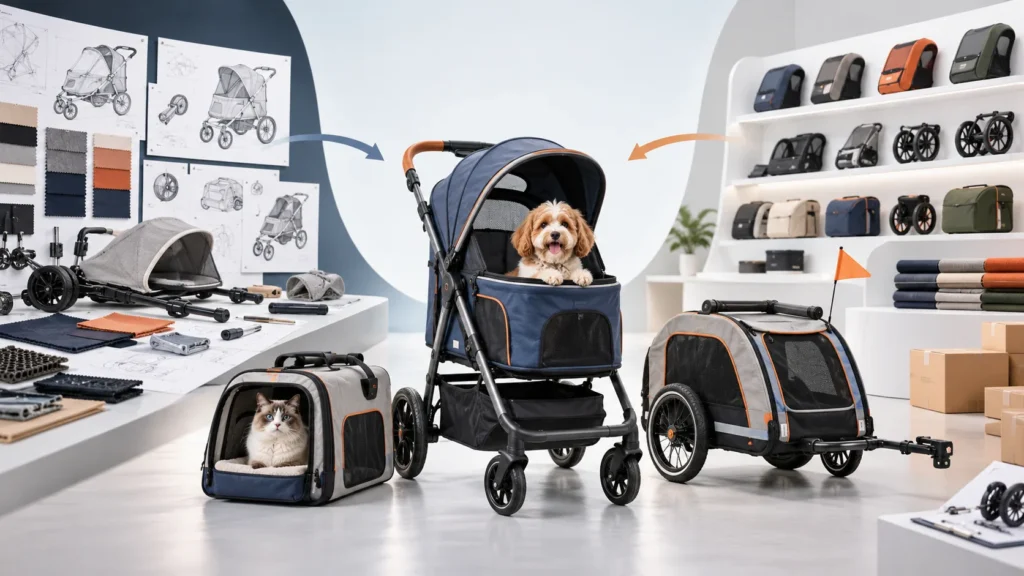
For pet brands, importers and distributors, the sourcing model behind a product influences development cost, launch speed, minimum order quantity, quality consistency, intellectual property and how easily the range can grow.
Two terms appear in almost every conversation with a pet products manufacturer in China: OEM and ODM. They are often used interchangeably, but they describe different starting points. With OEM, the buyer usually brings a defined design or detailed specification and the supplier manufactures to that brief. With ODM, the supplier provides an existing product platform or design capability that the buyer can select and modify.
Neither route is automatically better. The right choice depends on how mature your product idea is, how much differentiation your brand needs and how much time and capital you can commit before launch. This guide compares OEM vs ODM pet products from a buyer’s perspective and explains how to choose a practical route for pet strollers, dog bike trailers, carriers, car travel products, ramps, steps and mobility-support products.
What Are OEM Pet Products?
OEM stands for Original Equipment Manufacturer. In a typical OEM pet products project, the buyer owns or controls the main product concept and supplies a clear brief. That brief may include drawings, dimensions, material requirements, performance targets, colors, logo placement, packaging artwork, test requirements and an approved reference sample.
For example, a pet brand may approach a pet stroller OEM manufacturer with a defined cabin size, target load, wheel configuration, folding method, fabric specification and retail price. The supplier’s role is not simply to add a logo to a standard stroller. It is to translate the brand’s specification into a stable, repeatable production process.
OEM is usually a strong fit when:
- You already have a product design, technical drawing or validated sample.
- Product structure and performance are central to your brand positioning.
- You need exclusive features or a distinctive appearance.
- Your team and forecast volume can support tooling, sampling and a longer approval process.
The main advantage is control. The main challenge is responsibility: the more decisions your brand owns, the more complete your product brief and testing plan must be.
What Are ODM Pet Products?
ODM stands for Original Design Manufacturer. In an ODM pet products project, the supplier starts with an existing design, engineering platform or product family and adapts it for the buyer. Customization may include colors, fabrics, accessories, wheels, labels, manuals, logos and retail packaging. More substantial changes can be evaluated when the product platform allows them.
Imagine that a distributor wants to add a 2-in-1 dog bike trailer and stroller to its range. Instead of developing the frame and folding mechanism from zero, it may select a proven platform from a dog bike trailer manufacturer, then adjust the colorway, cabin fabric, reflective details, branding and packaging. This reduces technical uncertainty and can shorten the path from sample to bulk order.
ODM is often the better fit when:
- Speed to market matters more than complete design exclusivity.
- You want to test a new category before investing in custom tooling.
- Your team has a market concept but not a finished technical package.
- You need moderate differentiation across a broader pet mobility range.
ODM does not mean “generic” or “low quality.” A carefully selected platform can still support a clear brand identity. Define which elements are standard, which can be changed, and which changes affect MOQ, tooling, lead time or compliance.
OEM vs ODM Pet Products: Key Differences
| Decision factor | OEM pet products | ODM pet products |
|---|---|---|
| Starting point | Buyer-defined design or detailed specification | Supplier-developed platform or existing design |
| Product differentiation | High; structural and functional changes are possible | Moderate to high, depending on the platform |
| Development time | Usually longer | Usually faster |
| Upfront cost | Higher when engineering, prototypes or tooling are required | Lower when existing tooling and components are used |
| MOQ | May be higher due to custom materials and tooling | Often more flexible for standard platforms |
| Buyer involvement | High throughout development and approvals | Focused on selection, modifications and branding |
| Technical risk | Higher until the design is validated | Lower when the base product is already proven |
| IP considerations | Ownership should be defined for buyer designs and tooling | Usage rights and exclusivity should be clarified |
| Best for | Established brands and differentiated products | Faster launches, range extensions and market testing |
These are practical tendencies, not universal rules. A complex ODM modification may take longer than a straightforward OEM project. Likewise, a well-prepared OEM brief can move quickly. Always compare the actual scope behind a quotation instead of relying on the label alone.
What About Private Label Pet Products?
Private label is often the fastest option. The buyer selects an existing finished product and applies its own logo, label, manual or packaging while the construction remains unchanged.
For a new retailer, private label pet products can validate demand. A standard carrier can launch with branded packaging, progress to ODM fabric or accessory changes after sales are proven, and later become an OEM product with a proprietary structure.
Think of the three routes as a spectrum:
Private label → ODM customization → OEM development
Brands do not need to choose one model forever. A mixed strategy often makes more commercial sense: launch standard products quickly, customize proven winners and reserve full OEM development for the products that can become long-term brand assets.
How to Choose the Right Model for Your Brand
1. Start with product maturity
Ask what already exists. A conceptual brief is usually better suited to an ODM platform; drawings, a bill of materials, target dimensions and test criteria point toward OEM.
2. Define the level of differentiation
Not every product needs a new frame or mold. Buyers can differentiate through cabin proportions, entry height, storage, wheels, fabric, color, accessories and packaging. For a wholesale pet stroller supplier, color changes and structural changes have very different costs; separate them in the brief.
3. Set a realistic launch window
ODM usually reduces engineering and tooling steps, making it suitable for seasonal programs or quick range extensions. OEM requires more time for feasibility review, prototypes, revisions and pre-production approval.
Work backward from the required arrival date and include samples, approvals, materials, production, inspection, consolidation and transit.
4. Compare total landed cost, not only unit price
Compare tooling, samples, packaging, testing, inspection, freight, duty and the cost of delays—not only FOB price. ODM may reduce development cost; OEM can create stronger long-term margin when differentiation earns a better retail position.
5. Review MOQ by component
MOQ can be driven by fabric dyeing, wheels, molded parts, cartons or accessories. Ask for the minimum of each customized element; if volume is not viable, keep the structure standard and differentiate through colors, labels, manuals and packaging.
6. Clarify IP and tooling ownership
State who owns drawings, molds, patterns and artwork, plus the market, term and order commitment for any exclusivity. An OEM label alone does not guarantee protection; document confidentiality, tooling storage and reuse before development begins.
7. Match compliance to the destination market
Requirements differ by market and product. Agree on standards, test methods, labels, warnings and documents before production. Quality checks may include dimensions, loading, stability, locks, wheels, seams, zippers, restraint points, finish and packaging.
Which Model Fits Different Pet Mobility Categories?
| Category | Good ODM starting point | When OEM may be justified | Priority checks |
|---|---|---|---|
| Pet strollers | Proven frame with custom fabrics, colors, logo and packaging | New cabin geometry, folding system, wheels or load target | Frame stability, entry height, cabin dimensions and loading |
| Dog bike trailers | Standard or 2-in-1 trailer platform | Distinct towing, suspension, fold or cabin structure | Coupler, frame, wheels, reflectors, safety flag and enclosure |
| Pet carriers | Existing soft-goods pattern with branded trims and packaging | Proprietary structure or functional layout | Ventilation, seams, zippers, restraint points and care labels |
| Ramps and steps | Standard platform in selected materials and colors | Specific fold, grip, geometry, load target or vehicle fit | Stability, surface grip, hinges and product dimensions |
| Pet wheelchairs | Existing adjustable size platform | New geometry, connection system or size architecture | Adjustment range, materials, assembly and fitting guidance |
A dog bike trailer manufacturer, private label pet carriers supplier or pet wheelchair supplier should define category-specific inspection points. For mobility support items, avoid unsupported medical claims and provide accurate fitting guidance.
A Practical Sourcing Process for OEM and ODM Projects
A reliable project should move through defined checkpoints:
- Requirement review: Confirm the target market, product, estimated volume, target cost, quality level, customization, packaging and delivery expectations.
- Product and supplier matching: Compare suitable factories or platforms based on capability, MOQ, lead time, compliance and category experience.
- Specification confirmation: Record materials, dimensions, colors, functions, branding, packaging and acceptance criteria in one controlled specification.
- Sampling and approval: Evaluate the physical sample, document revisions and approve a final reference before production.
- Pre-production control: Confirm materials, approved components, packaging files and the inspection plan.
- Production follow-up: Track milestones and conduct in-line checks where the risk justifies them.
- Final inspection: Check the agreed sample, specification, quantity, function, appearance, labeling and packaging before shipment.
- Consolidation and delivery: Coordinate cartons, mixed loading, documents and international logistics.
This process matters in both models. A standard product can fail if the specification is vague, while a complex product can succeed when responsibilities and approval points are clear.
Why Work with Pet Mobility Source?
Pet Mobility Source is a B2B pet mobility and travel product supply-chain partner in Guangzhou, China. We support importers, distributors, wholesalers, retailers and pet brands across pet strollers, dog bike trailers, pet carriers, car travel products, pet ramps and steps, and adjustable pet wheelchairs.
Our value is coordination. Instead of asking buyers to manage several factories independently, we bring product selection, supplier matching, OEM/ODM development, sample approval, production follow-up, quality inspection, order consolidation and export delivery into one project workflow.
Our network and experience include:
- More than 10 years of supply experience.
- More than 30 verified partner factories.
- Products supplied to more than 40 export markets.
- OEM, ODM and private-label support.
- Pre-production review, in-line checks and final inspection.
- Multi-factory order consolidation and export coordination.
For growing brands, this makes a mixed pet mobility range easier to manage while retaining product-specific specifications and inspection criteria.
Questions to Ask Before Requesting a Quote
Prepare the following information to receive a more accurate proposal:
- Product category, use scenario and destination market.
- Private label, ODM or full OEM scope.
- Estimated quantity by model and color.
- Target landed cost and required arrival date.
- Essential dimensions, materials, functions and load requirements.
- Branding, packaging, testing and documentation needs.
The clearer the brief, the easier it is to match the right manufacturing route and avoid quotations based on different assumptions.
Frequently Asked Questions
Is OEM more expensive than ODM for pet products?
OEM often requires more upfront investment because it may involve engineering, prototypes, tooling and custom materials. ODM usually starts from an existing platform, which can reduce development cost. The final answer depends on the scope, volume and level of customization.
Which option has a lower MOQ?
ODM and private label often allow a lower starting quantity when standard materials and components are used. OEM quantities may be driven by custom tooling or component MOQs. Ask the supplier to explain which element sets the minimum.
Can an ODM pet product still look unique?
Yes. Colorways, fabrics, trims, accessories, labels, manuals and packaging can create a coherent brand presentation. Some platforms also allow functional changes. Confirm what is technically possible and whether any exclusivity is available.
Should a new pet brand choose OEM or ODM?
Many new brands benefit from ODM or private label for the first launch because these routes reduce development time and technical risk. Once sales data identifies a winning product, the brand can invest in deeper OEM differentiation.
Final Decision: OEM or ODM?
Choose OEM when you have a mature specification, need meaningful product differentiation and can support a deeper development process. Choose ODM when you want to launch faster, work from a proven platform and focus customization on the features customers can see and value. Choose private label when the priority is testing demand with minimal product changes.
The best sourcing model is the one that matches your current stage—not the one that sounds most sophisticated. Strong brands often use all three models at different points in their product roadmap.
Planning a new pet stroller, bike trailer, carrier, car travel or mobility-support range? Send Pet Mobility Source your target market, product category, estimated quantity, desired customization, packaging needs and delivery schedule. Our team will review suitable platforms and factories, recommend an OEM or ODM route, and prepare a project-based B2B quotation.