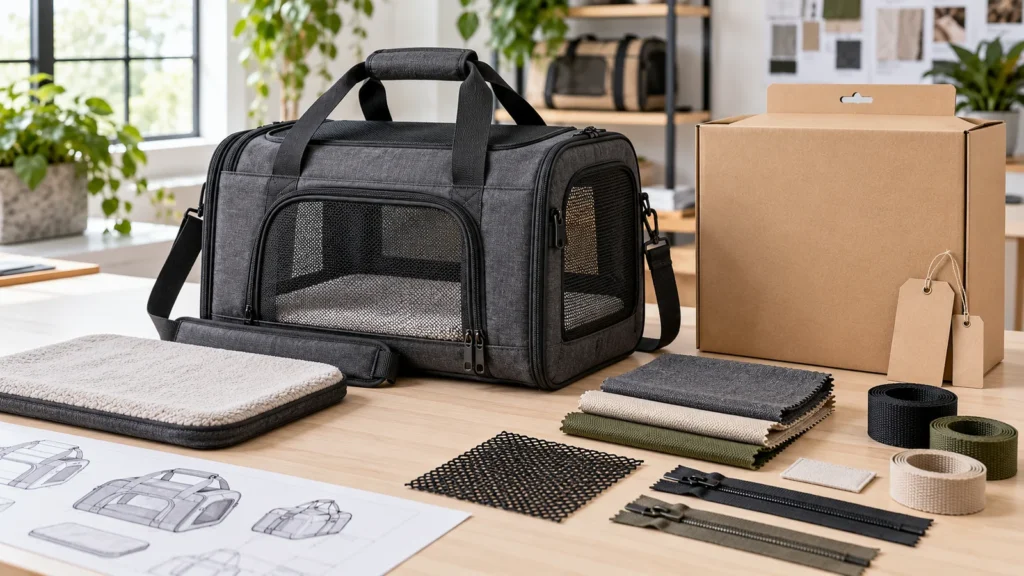
Private label pet carriers give brands and distributors an opportunity to build a recognizable product range. However, adding a logo is only one part of the purchasing decision.
Fabric, mesh, structural support, closures and packaging all influence how a carrier performs and how customers experience it. A product that photographs well may still create problems if its dimensions are unclear, its base lacks support or its packaging damages the approved shape.
For importers, the goal is to turn design preferences into measurable specifications before production.
This guide explains how to select materials, define customization, approve samples and plan packaging for private label pet carrier orders from China.
1. Define the Carrier’s Intended Use
Start with the application and sales channel rather than choosing a fabric or logo treatment.
A soft-sided carrier for occasional travel has different requirements from a backpack intended for regular carrying. An expandable carrier also needs separate dimensions for its closed and expanded configurations.
For wholesale soft-sided pet carriers, define the intended pet size, usable internal space, carrying method, entry arrangement and storage format.
Record the product’s external dimensions separately from the internal dimensions. Padding, frames and construction can reduce usable space.
A weight recommendation alone does not establish fit. Product information should help customers evaluate both the animal’s size and the carrier’s dimensions.
If airline travel is part of your positioning, review specific airline requirements before approving the product and marketing copy.
2. Write a Material Specification That Goes Beyond “Oxford Fabric”
“Oxford” describes a fabric construction, not a complete material specification. It does not, by itself, establish fiber composition, durability or water resistance.
Ask the supplier to identify the fiber, yarn specification, fabric weight where relevant, finish and backing.
Denier describes yarn linear density. A higher number alone does not prove that one finished carrier is stronger than another. Weave, coating, seams and overall construction also matter.
Use the following comparison framework when reviewing pet carrier fabric and mesh specifications:
| Component | Information to request | Sample assessment |
|---|---|---|
| Outer fabric | Composition, construction, weight and finish | Appearance, abrasion behavior and cleaning response |
| Mesh | Material, opening structure and attachment | Visibility, airflow pathways and resistance to damage |
| Lining | Composition, attachment and care method | Surface finish and accessibility for cleaning |
| Padding | Material, thickness and recovery | Support and consistency |
| Base support | Material, dimensions and construction | Shape retention under agreed loading |
| Webbing and hardware | Dimensions, material and attachment | Operation and connection integrity |
Approve the finished material combination rather than selecting each component in isolation.
3. Compare Polyester, Nylon and Other Shell Options
Polyester and nylon are common starting points for fabric carrier discussions. Their suitability depends on the particular material grade and finished construction.
Compare actual swatches and samples rather than relying on generic claims about either fiber.
A coated fabric may offer useful resistance to surface moisture, but that does not make the assembled carrier waterproof. Seams, zippers and ventilation areas affect the complete product.
Canvas-style fabrics can support a particular visual identity, while coated or synthetic finishes may suit a different positioning. Evaluate weight, cleaning instructions and appearance after handling.
For recycled-material options, confirm the claimed content and supporting documentation. Avoid extending evidence for one component into an unsupported claim about the entire carrier.
Ask suppliers to identify material substitutions before production so you can assess their effect.
4. Evaluate Mesh, Ventilation and Closures Together
Mesh panels influence visibility and airflow, but their performance depends on placement and construction.
Review the complete carrier with pockets, covers and accessories in their intended positions. Check whether carrying the bag or placing it against another surface blocks openings.
Inspect mesh attachment at seams and around corners. Ask how resistance to relevant damage will be evaluated; avoid treating “scratch-proof” as an automatic material property.
Zippers and other closures should be accessible to the user and appropriate to the intended containment function. Review slider operation, end stops and closure alignment.
Do not infer escape resistance from one component alone.
For in-cabin travel, IATA warns that compressing soft-sided carriers can reduce ventilation. Its guidance also notes that individual airlines may impose additional requirements. IATA cabin-travel guidance
5. Specify the Base, Handles and Shoulder Straps
The carrying system deserves as much attention as the outer fabric.
Ask how the base supports the intended load and whether its insert is removable. Inspect edges, padding coverage and the way the insert fits inside the carrier.
Evaluate handles, shoulder straps, adjustment hardware and their attachment points as one system. Reinforced stitching should correspond to an agreed construction detail rather than a vague marketing description.
Define the intended working load and how it will be assessed. Identify the sample configuration, test setup and acceptance criteria.
Review the carrier’s shape under the agreed conditions, including whether excessive deformation affects internal space or closure operation.
Also check the empty product weight. Added padding and hardware may change carrying convenience even when they improve another feature.
6. Define the Scope of OEM Pet Carrier Customization
Suppliers may use private label, OEM and ODM differently. Agree the actual work rather than relying on the terminology.
Separate branding changes from material changes and structural development.
Custom logo pet carrier bags may use an existing platform with approved colors, labels and packaging. Changes to dimensions, entry panels, base construction or carrying attachments require a broader review.
A practical customization brief includes:
- Reference model and version.
- Required dimensions and tolerances.
- Approved materials and colors.
- Logo method, size and placement.
- Labels, instructions and accessories.
- Packaging format and artwork.
- Sample and inspection requirements.
Record which features remain unchanged and which require development.
Confirm additional charges, sampling stages and approval responsibilities before requesting production.
7. Choose Logo Treatments on the Actual Material
Screen printing, embroidery, woven labels and patches create different visual results. Suitability depends on the fabric, logo detail and placement.
Request artwork in an appropriate vector format and provide a size reference. Approve the mark on the actual material rather than on a digital rendering alone.
Check legibility, color, edge quality and placement across the intended size range.
Embroidery may affect a panel differently from a printed logo. A patch introduces an additional material and attachment method. Evaluate those effects on the finished carrier.
Specify color references for the shell, mesh, webbing and branding, recognizing that different materials may not appear identical under all lighting.
Retain the approved physical references and document how production color differences will be assessed.
8. Plan Retail and Shipping Packaging Separately
Custom packaging for pet carriers serves several purposes: presentation, protection, identification and handling.
A retail box may support shelf display and product explanation. A protective bag with a sleeve or hang tag may suit another channel. The correct choice depends on the buyer’s distribution process.
The export carton needs a separate specification, including dimensions, packing arrangement, weight and protection.
Confirm that folding or compression does not damage the frame, mesh, base or branding. Open a packed sample after an agreed storage period and review its presentation.
If products will be dispatched individually to customers, evaluate that shipping format too.
Retail-ready packaging is not automatically suitable for parcel delivery, and a strong outer carton does not resolve poor protection inside the unit pack.
9. Calculate Packaging Volume Before Comparing Freight
Foldable pet carrier packaging dimensions can materially affect storage and shipping comparisons.
Use actual proposed carton measurements. For example, a carton measuring 60 × 40 × 50 cm occupies 0.12 cubic meters. One hundred such cartons total 12 cubic meters before allowances for pallets or other requirements.
This is a volume illustration, not a freight quotation or container-loading guarantee.
Ask the supplier for units per carton, gross weight and packing orientation. Confirm whether quoted dimensions include the complete retail packaging.
Compare alternatives using the same service and destination.
A smaller carton is useful only if the product remains adequately protected and returns to its approved condition. Include repacking, handling and potential damage costs when evaluating a proposed saving.
10. Approve Packaging Copy and Product Claims
Packaging should communicate the product clearly without promising performance that has not been established.
Check dimensions, care instructions, contents, intended use and relevant warnings against the approved product.
Avoid broad statements such as “universally airline approved,” “escape-proof” or “waterproof” without an appropriate basis.
IATA states that it does not certify or endorse commercial pet travel containers. Airline acceptance must therefore be checked through the relevant requirements rather than inferred from an “IATA approved” label. IATA guidance on pet containers
Confirm destination-market labeling and documentation needs with the appropriate specialists.
Keep product labels, retail artwork and online descriptions consistent. Record the approved artwork version so an outdated file does not enter production.
11. Use a Pet Carrier Sample Approval Checklist
A useful sample approval process connects appearance with construction and documentation.
Inspect dimensions, materials, stitching, mesh, closure operation, carrying attachments, base support, removable components and accessories.
Check logo execution, labels, instructions and packaging against the approved files.
Where performance tests are required, agree the methods and acceptance criteria before testing. A sample review should not become an improvised test with unclear conclusions.
Document issues individually and confirm the proposed correction. Approve revised samples where the change requires physical verification.
Retain a reference sample and the matching specification.
For bulk production, define inspection scope, reporting, defect treatment and release responsibility. Carton counting alone does not establish that finished carriers match the approved configuration.
12. Compare MOQ, Development Cost and Lead Time
Private label pet carrier MOQ depends on the selected platform and customization. Fabric colors, labels, patches and packaging may have separate minimum quantities.
Ask whether leftover branded components will be stored, charged separately or used only after approval. Record ownership and handling arrangements.
Separate product price from sampling, development, decoration setup, packaging tooling and testing costs.
Likewise, distinguish sample preparation, revisions, material procurement, production, inspection and transport.
Confirm what starts each stage. Unapproved artwork or a late material change may affect the schedule.
Use comparable quotations with the same product and packaging specifications.
For repeat orders, require notification of changes to materials, components or construction rather than assuming the original product will remain unchanged.
A Buyer’s Private Label Carrier Checklist
Before approving a bulk order, confirm the following:
| Area | Approval question |
|---|---|
| Intended use | Is the carrier’s application clearly defined? |
| Fit | Are internal and external dimensions recorded? |
| Materials | Are shell, mesh, lining and base specified? |
| Construction | Are carrying attachments and closures approved? |
| Branding | Has the actual logo treatment been checked? |
| Packaging | Has the packed product been reviewed? |
| Claims | Are statements supported and appropriately qualified? |
| Quality control | Are inspection and release conditions documented? |
| Commercial terms | Are MOQ, charges and milestones clear? |
| Reorders | Is a change-notification process agreed? |
Resolve outstanding questions before production approval.
How Pet Mobility Source Supports Your Project
Pet Mobility Source works as a B2B pet travel and mobility supply-chain partner.
Our services include product selection, supplier coordination, OEM/ODM project management, sample confirmation, quality-control coordination and export preparation.
For private label pet carriers, we help connect the buyer’s requirements with suitable product options, material choices, branding and packaging approvals.
Buyers sourcing across several categories can also discuss compatible order consolidation.
Each proposal is reviewed around the selected product, destination market, quantity and customization requirements. Available materials, minimum quantities, inspection arrangements and shipment conditions are confirmed for the project.
Frequently Asked Questions
Can an existing pet carrier be customized with my logo?
Selected platforms may support branding changes. Confirm the logo method, placement, minimum quantity and sample requirements for the chosen product.
Which material is best for a private label carrier?
There is no universal answer. Compare finished materials against the intended use, construction, cleaning requirements and agreed evaluation criteria.
Can soft-sided pet carriers be packed flat?
Some designs support folded packing. Verify the effect on frames, padding, mesh and presentation using an approved packed sample.
Are private label carriers automatically airline approved?
No. Review the relevant airline’s requirements and the specific carrier configuration. Avoid implying universal acceptance.
Start Your Private Label Pet Carrier Project
Prepare your target market, reference style, intended pet size, dimensions, quantity, material preferences and branding requirements.
Include packaging expectations and any required evaluation or documentation.
Request a project-based quotation to discuss product matching, sampling, customization, quality-control coordination and export preparation with Pet Mobility Source.