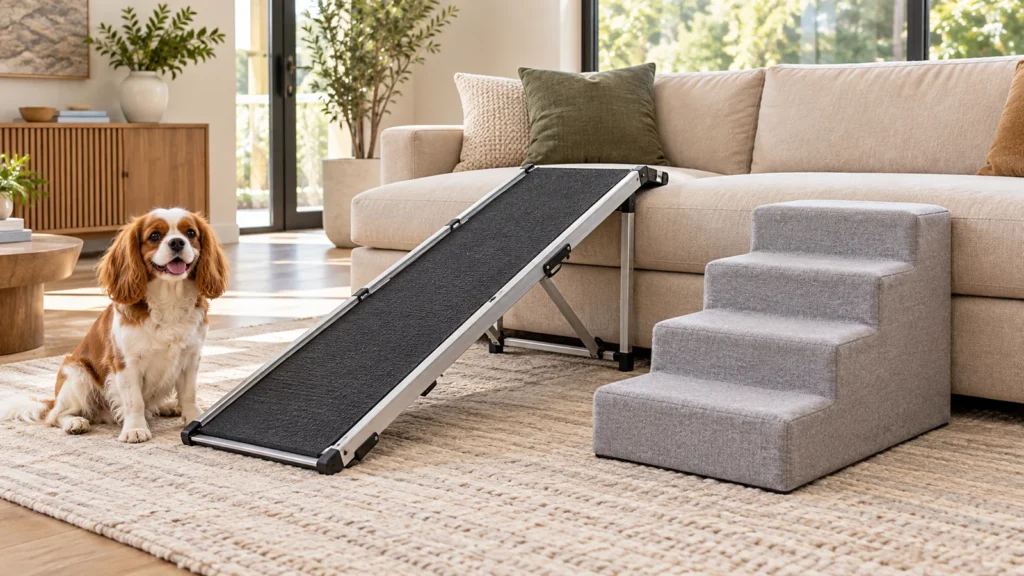
Choosing between dog ramps and pet steps is a product-range decision that affects customer fit, shipping costs, merchandising and after-sales support. For distributors and importers, the best option depends on where the product will be used, which dogs it is intended for and how efficiently it can move through your sales channel.
A dog ramp provides a continuous inclined surface. Pet steps provide individual treads. Both help pets access raised surfaces, but they require different dimensions, materials and product explanations.
This dog ramp vs pet steps wholesale buying guide explains how to compare designs, evaluate samples and prepare a purchasing brief. It also shows how to build a focused range without ordering multiple products that serve almost identical needs.
Dog Ramp vs Pet Steps: The Key Differences
Start with the intended application rather than the product name. A bedside access product and a vehicle access product may look similar in a catalogue while having very different performance requirements.
| Buying consideration | Dog ramps | Pet steps |
|---|---|---|
| Access format | Continuous walking surface | Separate steps with defined rise and tread depth |
| Common applications | Vehicles, beds and sofas, depending on design | Beds and sofas; vehicles with suitable purpose-built designs |
| Dimensions to compare | Length, usable width, supported height and incline | Total height, step rise, tread depth and usable width |
| Storage considerations | Folded length or telescopic dimensions | Fixed footprint, folding size or compressed packing format |
| Important sample checks | Surface grip, flex, hinges, locks and support contact | Stability, tread support, cover fit and base grip |
| Packaging concerns | Long cartons, hinge protection and surface damage | Carton volume, deformation and recovery for compressed foam |
Neither category is automatically the better wholesale purchase. A distributor serving indoor pet retailers may prioritize compact steps, while a vehicle-access range needs products matched to realistic loading heights and storage spaces.
1. Match Wholesale Dog Ramps and Pet Steps to the Sales Channel
Indoor access: beds and sofas
For indoor retailers and online home-product sellers, foam dog stairs for beds and sofas are a useful category to evaluate. Relevant features include removable covers, base grip, step geometry and visual compatibility with home interiors.
Total height alone is insufficient. Two products with the same height can have different step rises, tread depths and footprints. Product listings should show these measurements so customers can compare the stairs with their furniture and available floor space.
An adjustable indoor ramp offers another access format. Buyers should inspect how each height setting is supported and how much floor space the ramp occupies at that setting.
Vehicle access: cars, SUVs and travel
Buyers sourcing folding dog ramps for SUVs should compare vehicle loading height, usable ramp length, walking width and the way the upper end contacts the vehicle.
Storage dimensions matter too. A product that works when open may be inconvenient if it does not fit the customer’s boot or storage compartment.
Telescopic dog ramps wholesale projects require attention to sliding sections, locking operation and maintenance instructions. Folding designs require checks around hinges, deployment and finger clearance.
Small-dog and larger-dog ranges
Wholesale dog steps for small dogs need dimensions appropriate to the intended users. Larger-dog products need sufficient usable space and a structure evaluated under an agreed test method.
Avoid treating breed names as complete specifications. Define the intended pet size, product dimensions and tested load conditions instead.
2. Compare Geometry Before Comparing Price
Dimensions help explain why two similar-looking products can perform differently.
For ramps, the incline depends on both access height and ramp length. As a simplified illustration, a straight ramp measuring 150 cm along its walking surface and reaching a height of 60 cm has an angle of approximately 23.6 degrees. At the same height, a 120 cm ramp has an angle of approximately 30 degrees.
These figures illustrate geometry; they are not recommended angles or proof that either product is suitable for a particular dog. Actual positioning, support contact and product design must also be considered.
For pet steps, compare:
- Total access height.
- Rise between consecutive treads.
- Usable tread depth and width.
- Base footprint.
- Support beneath each tread.
- Clearance at the top landing.
Ask suppliers for a dimensioned drawing. This makes comparison more reliable than estimating proportions from photographs and helps prevent errors when preparing retail product pages.
3. Choose Materials for the Intended Application
Material selection affects product weight, appearance, cleaning, durability and shipping.
Foam steps deserve close inspection of foam consistency, tread support, cover construction and the way the product holds its shape. If compressed packaging is proposed, evaluate recovery after unpacking and record the conditions used during that evaluation.
Rigid plastic steps require checks for excessive flex, surface finish, base stability and folding mechanisms where fitted.
For wooden ramps or stairs, inspect joints, finish consistency, surface coverage and assembly instructions. A premium appearance should be supported by satisfactory sample performance.
For aluminum ramps, compare overall construction rather than material name alone. Inspect the frame, joints, walking surface, edges and opening mechanism.
A lighter unit may be easier to handle, but product weight does not establish load capacity. Likewise, a heavier unit is not automatically more stable. Evaluate the complete design.
4. Verify Load Capacity and Non-Slip Performance
A catalogue load rating is a starting point for discussion. Before approving wholesale dog ramps or pet steps, ask how the stated capacity was established.
The test record should identify the model, setup, loading position, duration and acceptance criteria. Confirm whether the result concerns a static load or includes repeated loading and other relevant conditions.
A centered load test may not reveal what happens when weight is applied near an edge or connection. Your inspection plan should reflect the intended application rather than relying on a single headline number.
Evaluate non-slip pet steps and ramps as complete systems. The walking surface, base, support contact and installation method all affect performance.
Suggested sample checks include movement under loading, surface attachment, locking operation, visible flex, sharp edges and consistency between units. Where outdoor use is claimed, agree how relevant exposure conditions will be evaluated.
Keep marketing language aligned with the evidence. “Non-slip” should not become an unconditional promise of performance on every surface.
5. Calculate Landed Cost, Not Just Unit Price
For distributors, the lowest factory quotation may not produce the best commercial result.
Compare landed cost using a consistent destination and shipping basis. Include the product, customization, packaging, inspection, freight, insurance and applicable import charges. Add local handling, warehousing and delivery costs where relevant.
Packaging deserves particular attention. A small change in carton dimensions can affect container utilization, storage space and parcel shipping charges.
Request:
- Retail package dimensions and gross weight.
- Master-carton dimensions and units per carton.
- Packing orientation and protective materials.
- Pallet details, where applicable.
- Compression or nesting information.
- Loading assumptions used in freight estimates.
Evaluate packaging savings against product recovery and damage risk. A foam stair packed more tightly is only commercially useful if it returns to the agreed shape and remains presentable after unpacking.
Use the approved packing specification for freight comparisons.
6. Plan Private Label Dog Ramps and OEM Pet Stairs
Private-label development should begin with a clear buyer brief. Define your market, sales channel, target positioning and essential specifications before selecting colors or logo placement.
For private label dog ramps, useful options to discuss include surface appearance, labels, instructions, retail packaging and brand presentation.
For OEM pet stairs, the brief may also address cover fabric, color, cleaning instructions, dimensions and packing format. Confirm which changes are available on an existing platform and which require additional development.
Distinguish cosmetic changes from structural changes. A revised logo may have limited implications, while changes to dimensions, foam construction, hinges or load-bearing parts may require renewed evaluation.
Approve a reference sample and record the agreed specifications before production. Your approval package should connect the physical sample with drawings, materials, artwork and inspection criteria.
This gives both buyer and supplier a practical basis for resolving differences during production.
7. Confirm MOQ, Sampling and Lead Time Together
Dog ramp MOQ and lead time should be assessed as connected purchasing conditions.
Ask whether minimum order quantities apply to the model, color, cover fabric, packaging design or complete order. A proposed mixed order does not necessarily remove the minimums for individual components.
Separate the purchasing schedule into sampling, revisions, approval, material preparation, production, inspection and transport.
Confirm what starts each stage. For example, production timing may depend on approved artwork, sample confirmation and material availability.
When reviewing wholesale pet steps quotations, ask whether a sample represents the same materials and construction intended for the bulk order. Record any differences before approval.
Plan replenishment around actual sales and stock coverage. A manageable first order with clear reorder conditions can be more useful than a broad assortment that ties up working capital before demand is understood.
8. Build a Focused Distributor Assortment
Start with distinct customer applications. An initial range might include indoor steps, an indoor ramp and a vehicle ramp, provided each has a clear role in your sales channel.
Avoid launching several nearly identical products simply because they are available. Each additional SKU adds photography, listing, inventory and support work.
Use a comparison sheet to explain what differentiates each item: application, access height, dimensions, storage format, cleaning method and approved load information.
For online sales, prioritize content that answers practical questions. Show the product open and stored, include dimension diagrams and explain installation or placement.
After launch, review sales alongside returns and customer questions. Repeated questions about height or fit may indicate missing listing information. Repeated complaints about deployment or assembly may require a product or instruction change.
Expand the assortment when these observations identify a clear opportunity.
9. Choose a China Sourcing Partner Around Project Control
When comparing a dog ramp supplier in China or a pet stairs wholesale supplier, establish who manages specifications, sample approvals, production checks and shipment preparation.
Pet Mobility Source operates as a B2B supply-chain and OEM/ODM partner. Its Pet Ramps & Steps range includes ramp and stair sourcing options for indoor and vehicle applications.
Our project support covers supplier matching, sample coordination, customization, production follow-up and export preparation. Buyers can also discuss order consolidation across compatible product categories.
Our quality-control approach includes specification confirmation, approved samples, production inspection and test-document coordination.
For your project, confirm available configurations, MOQ, sampling conditions, testing requirements and delivery arrangements in the quotation. Clear approvals and documented requirements provide the foundation for repeat orders.
10. Prepare a Complete Wholesale Inquiry
A detailed inquiry helps suppliers propose relevant products and makes competing quotations easier to compare.
Include:
- Destination market and sales channel.
- Indoor or vehicle application.
- Intended pet size and access height.
- Required dimensions and load specification.
- Preferred materials and storage format.
- Initial order quantity and expected replenishment.
- Branding and packaging requirements.
- Inspection or testing requirements.
- Delivery destination and requested shipping basis.
If your brief is still developing, explain which requirements are fixed and which are open to recommendation.
For example, an importer may have a firm retail package size but remain flexible on the folding design. Another buyer may prioritize a particular furniture height while allowing changes to fabric and color.
That distinction helps the sourcing team evaluate suitable options without making assumptions.
Frequently Asked Questions
Are dog ramps or pet steps better for a distributor?
Choose according to application and customer fit. Compare access geometry, usable dimensions, storage, packaging and sample performance. Many distributors can serve distinct needs with both categories.
Can dog ramps and pet steps be ordered under a private label?
Branding and packaging options can be discussed for selected products. Confirm available customization, minimum quantities and any additional sample or evaluation requirements before approval.
What is the MOQ for wholesale dog ramps?
MOQ depends on the selected product and customization. Request separate confirmation for the model, color and packaging, together with repeat-order conditions.
How should importers evaluate pet ramp quality?
Use an approved specification and a documented inspection plan. Review dimensions, stability, surface attachment, mechanisms, load evidence and packing consistency.
Does a high load rating guarantee suitability?
No. Suitability also depends on dimensions, access height, installation, surface grip and the intended user. Present the rating with its relevant test conditions.
Discuss Your Dog Ramp and Pet Steps Sourcing Project
A successful range combines suitable product geometry, verified specifications, practical packaging and dependable order coordination.
Explore our wholesale pet ramps and dog steps, then share your destination market, quantities, application and branding requirements.
Request a project-based wholesale quotation to discuss product matching, sampling, customization and shipment preparation for your next distributor or private-label order.