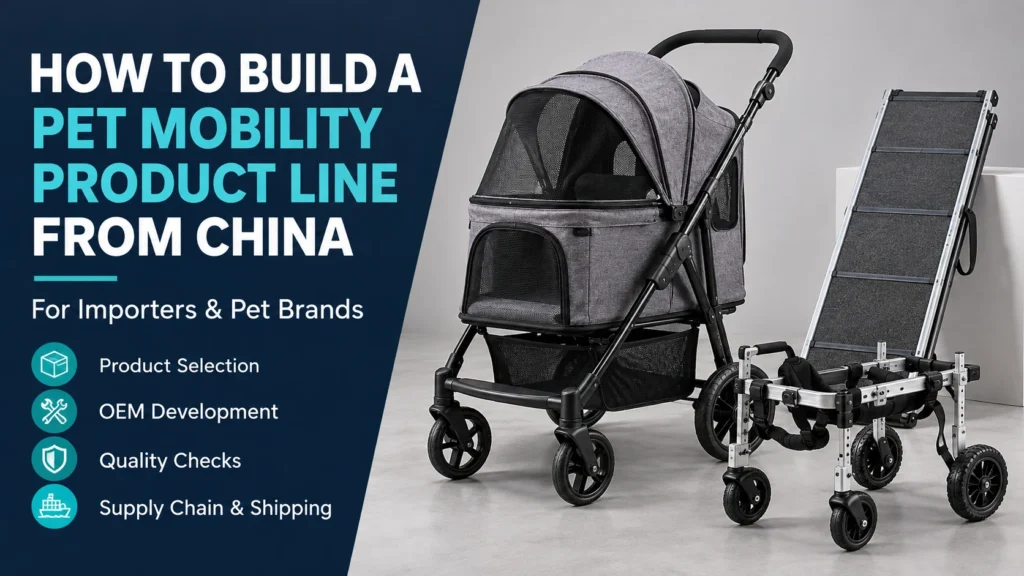
Building a pet mobility product line requires more than finding a supplier and placing logos on existing products. Importers and brands need a defined customer, a manageable assortment, consistent specifications and a supply process that supports repeat orders.
The category can include pet strollers, dog wheelchairs, ramps, steps, carriers and related travel products. These items serve different purposes and require different purchasing decisions. A stroller’s cabin dimensions cannot replace a wheelchair fitting guide, and a ramp’s load rating does not establish its suitability for every vehicle.
This guide explains how to source pet mobility products from China, structure OEM development and manage quality across multiple categories. It also outlines how Pet Mobility Source helps buyers coordinate the work between product selection and shipment.
1. Define What “Pet Mobility” Means for Your Brand
Start with the customer problem you intend to address.
Your range might focus on everyday outings, access to vehicles and furniture, transport for larger pets, or products that provide movement support. These are related themes, but they are not interchangeable.
Choose an initial positioning such as:
- Urban pet travel and daily outings;
- Vehicle access and road-trip products;
- Spacious transport for larger pets;
- Adjustable mobility-support equipment;
- A coordinated range for specialist distributors.
Define destination markets, sales channels, pet-size requirements and the level of customer support your business can provide.
For products used by pets with health-related mobility needs, avoid turning a retail description into a treatment promise. Individual suitability may require professional assessment.
A precise positioning brief makes supplier comparison and product development more useful.
2. Build a Focused Assortment Before Expanding
A large catalog creates more approval decisions, inventory commitments and service requirements. Begin with a range your team can explain and maintain.
Organize products into three roles:
| Product role | Purpose | Example |
|---|---|---|
| Core product | Establishes the main customer proposition | Stroller, ramp or wheelchair |
| Complementary product | Serves a related need | Carrier, travel mat or compatible cushion |
| Service component | Supports use and replacement | Harness, wheel, fastener or liner |
These examples are planning options, not a recommendation to launch every category together.
A useful starting assortment might combine one core platform with a small number of size variants and clearly compatible accessories. Expand after understanding customer questions, returns and replenishment needs.
Do not introduce a product solely because it appears popular in a supplier catalog.
3. Create a Product Requirement Sheet for Each Category
Before requesting quotations, turn your range plan into written requirements.
For each proposed SKU, record:
- Intended use and customer;
- External and usable dimensions;
- Rated capacity and its supporting basis;
- Materials and important components;
- Adjustment or folding requirements;
- Included accessories;
- Cleaning and maintenance instructions;
- Packaging and documentation needs.
Separate essential requirements from preferences. A color option may be negotiable; a necessary size or installation feature may not be.
Use the same requirement sheet when approaching suppliers. Otherwise, one quotation may describe a basic platform while another includes accessories and upgraded components.
Clear specifications also make later sample approval and inspection more objective.
4. Select Pet Strollers by Space, Structure and Operation
For pet stroller wholesale sourcing, compare usable cabin dimensions and rated capacity separately. Weight alone does not establish whether a pet has sufficient room.
Review entry design, enclosure closures, ventilation, wheels, brakes and folding arrangements. Confirm what the quoted configuration actually includes.
Ask for demonstrations of assembly, folding and accessory attachment. Record operating restrictions and the dimensions needed for storage.
Labels such as “large dog,” “heavy-duty” and “all-terrain” require model-specific support. Do not apply them based on photographs or frame appearance.
Explore our Pet Strollers range as a starting point, then request the selected model’s confirmed specification and sample options.
5. Treat Wheelchairs, Ramps and Steps as Distinct Categories
Dog wheelchair wholesale purchasing requires detailed sizing and adjustment information. Ask how body measurements connect to frame and harness sizes, and which support components are supplied.
Review replacement harnesses, fasteners and wheels before launch. Instructions should match the actual model rather than a similar-looking product.
For ramps and steps, confirm usable dimensions, support arrangements, surface construction and the conditions behind capacity claims. Consider access height and installation, not merely maximum load.
Avoid presenting a wheelchair as suitable for every animal or a ramp as appropriate for every vehicle.
Review our Pet Wheelchairs and Pet Ramps & Steps for category discussions. Confirm individual product requirements before final selection.
6. Choose Between Existing Platforms and New Development
Private label pet mobility products can follow different development routes.
Existing platform: Select an established model and discuss available branding, colors, packaging and accessories.
Configured platform: Modify agreed components or features within the supplier’s demonstrated capability.
New development: Create a different structure, component or product from drawings and a defined technical brief.
Each route has different sample, tooling and verification requirements. Do not treat structural changes as simple logo customization.
For new tooling, clarify ownership, usage rights, maintenance and access arrangements in the commercial agreement. Confirm whether development costs are separate from production pricing.
Choose the least complex route that can genuinely meet your positioning and specification.
7. Assess Suppliers at Product Level
A company offering many pet products may use different manufacturing resources for each category. Ask who makes the selected item and who controls specifications, materials and changes.
Review supplier capability through relevant evidence:
- Comparable product samples;
- Production and assembly information;
- Component sourcing and consistency;
- Inspection arrangements;
- Documentation;
- Replacement-part support.
A facility audit or general certificate does not establish the performance of every finished product.
For a multi-category range, different specialist suppliers may be appropriate. The important requirement is a coordinated process that maintains accountability for each SKU.
Pet Mobility Source works as a sourcing and project-management partner, helping buyers organize supplier comparison and product-specific decisions.
8. Compare Quotations on the Same Basis
Prepare a comparison sheet instead of choosing the lowest headline price.
Include the model, configuration, materials, accessories, packaging, MOQ, sample terms, production timing and delivery scope.
For example, compare a stroller with its stated wheels, brake arrangement and cushion against the same configuration from another supplier. Do not compare a complete retail kit with a frame-only price.
Ask suppliers to identify exclusions and unresolved details.
Record the validity period and any assumptions affecting price. Changes to order mix, packaging or components may alter the quotation.
This approach makes negotiation more productive because cost differences can be connected to specific decisions.
9. Coordinate Branding Across Different Materials
A coherent collection can share colors, typography, labels and packaging without using identical construction.
Fabric, plastic, coatings and metal finishes may interpret the same color reference differently. Review physical samples under agreed conditions.
Confirm logo dimensions, application methods and placement. Branding should not obstruct ventilation, controls, instructions or component operation.
For OEM pet mobility products, maintain both a collection-level identity guide and individual SKU specifications.
Packaging should communicate product differences clearly. A shared visual style must not obscure different capacity limits, assembly requirements or intended uses.
Approve artwork alongside the actual product configuration.
10. Use Samples as Decision Tools
Sample review should answer specific purchasing questions.
Evaluate assembly, adjustment, fit, dimensions, workmanship, cleaning and packaging. Ask whether the sample uses the intended production components.
Record findings and required changes. Photograph the approved version and identify important parts.
Where practical, assess user instructions with someone unfamiliar with the product. Confusing steps often reveal gaps that experienced supplier staff overlook.
A sample approval should specify exactly what has been accepted. It should not imply that every performance claim has been verified.
For features requiring testing, agree on a separate method and supporting evidence.
11. Establish a Category-Specific Quality Plan
A single checklist cannot adequately cover strollers, wheelchairs, fabric carriers and ramps.
Create inspection criteria linked to each specification.
| Category | Inspection priorities |
|---|---|
| Strollers | Dimensions, assembly, wheels, brakes, closures and folding |
| Wheelchairs | Adjustment range, harnesses, connections and complete parts |
| Ramps | Dimensions, support structure, surface and attachment |
| Carriers | Seams, mesh, closures, handles and internal space |
| Travel accessories | Capacity, fit, closures, compatibility and workmanship |
Agree on sampling and acceptance criteria. Identify which checks occur before production, during assembly and before shipment.
A visual inspection should not be described as proof of every load, durability or safety claim.
Pet Mobility Source coordinates quality-control activities against the agreed scope.
12. Review Claims and Documentation Before Packaging
Decide which claims your brand intends to make before approving labels and product pages.
Ask what evidence supports statements such as “waterproof,” “tested capacity,” “airline suitable” or “crash-tested.” Check the exact model, configuration and limitations covered.
Do not combine unrelated reports into a general “fully certified” claim.
Have destination-market requirements reviewed for the actual product. Requirements may differ across categories and configurations.
Prepare accurate assembly, maintenance, sizing and use instructions. Use consistent measurements and terminology throughout the product page, packaging and manual.
Resolving these decisions before production reduces the risk of reprinting packaging or withdrawing unsupported descriptions after launch.
13. Calculate Landed Cost and Inventory Exposure
For wholesale pet mobility products, unit price is only one part of the commercial decision.
Calculate:
Product cost + development + packaging + inspection + freight + applicable import charges + local handling + support provision
Request carton dimensions, gross weight and packing quantity by SKU. Larger products may consume a significant share of container and warehouse space.
Assess the cost of spare parts, missing-component shipments and customer support.
Compare inventory commitments by size and color. A broad assortment can tie up purchasing funds even when individual unit margins appear attractive.
Use conservative sales assumptions for a new range and plan how slow-moving variants will be handled.
14. Plan MOQ and Replenishment by SKU
MOQ can differ by model, color, material, branding and packaging. Ask for each minimum separately.
Build a purchasing matrix showing:
- Quantity by SKU;
- Minimum order requirements;
- Sample and artwork status;
- Production readiness;
- Replacement-part quantities;
- Reorder expectations.
Mixed-product consolidation does not automatically eliminate factory minimums.
For repeat orders, confirm whether colors, components and packaging remain available. Require review of substitutions before they enter production.
A dependable replenishment process can be more valuable than launching many variants that cannot be repeated consistently.
15. Coordinate Production and Consolidated Shipping
Multi-supplier orders need shared milestones.
Set dates for specification approval, samples, packaging, production, inspection and delivery to the consolidation point. Identify what happens if one category is delayed.
Confirm responsibilities for storage, handling, repacking and shipment release.
Packaging should protect each product’s vulnerable features. Avoid packing loose hardware where it can damage textiles or finishes.
Keep packing lists and carton marks connected to SKU and version records.
Pet Mobility Source supports production follow-up, order consolidation and export coordination within the agreed project scope. Shipping arrangements should be reviewed against product readiness and the buyer’s delivery requirements.
16. Build After-Sales Support Before the First Shipment
Prepare replacement-part and service arrangements before customers receive the products.
Request codes and compatibility information for wheels, harnesses, cushions, fasteners, buckles and other relevant components.
Define how retailers should submit photographs, identify versions and report suspected defects.
Warranty terms should distinguish manufacturing defects, incorrect assembly, unsuitable use and normal wear. Clarify responsibility for parts, labor and transport.
Maintain a record connecting the approved specification, production version and customer instructions.
After launch, use support questions and returns to improve the next order. Review evidence before changing the product rather than reacting to isolated comments.
How Pet Mobility Source Supports Your Product Line
Pet Mobility Source is a China-based pet mobility and travel sourcing and OEM/ODM project-management partner.
Our service approach includes product selection, supplier coordination, specification review, sample approval, branding development, production follow-up, inspection coordination and export planning.
We help importers, distributors and pet brands organize multiple purchasing decisions through a defined project workflow.
Explore our product range and OEM/ODM services to begin the discussion.
Model availability, customization, testing, MOQ, timing and after-sales arrangements are confirmed according to the selected products and suppliers.
Frequently Asked Questions
Which category should a new brand launch first?
Choose a category connected to a clear customer need and your ability to provide sizing, instructions and after-sales support.
Can several products share one private-label identity?
Yes, subject to development feasibility. Each SKU still needs separate specifications, approvals and accurate documentation.
Is one factory necessary for the whole range?
No. Specialist suppliers may be appropriate for different products, provided specifications, approvals and responsibility are coordinated.
How can I compare suppliers fairly?
Use the same requirement sheet and compare complete configurations, included accessories, documentation, inspection and service arrangements.
What should I send in my first inquiry?
Provide the target market, sales channel, product references, quantities, size requirements, branding brief and delivery expectations.
Start Your Pet Mobility Sourcing Project
Planning to build a pet mobility product line from China?
Send Pet Mobility Source your proposed assortment, destination market and brand positioning. Include essential specifications, target quantities and sample expectations.
We can review suitable supply options and help structure a project-based quotation.