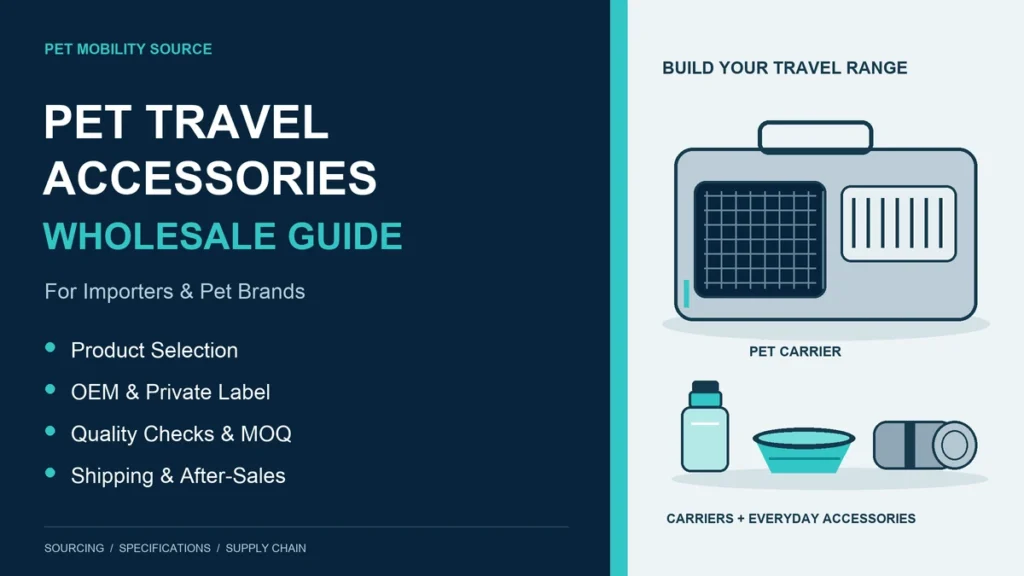
A successful pet travel collection needs more than a selection of attractive products. Importers must decide which items belong together, how customers will use them, and whether specifications, packaging and supply arrangements support the intended positioning.
A carrier, car seat cover and travel bowl may share a color palette, but they have different construction, testing and documentation needs. Adding more categories also creates more suppliers, approval decisions and shipment dependencies.
This pet travel accessories wholesale guide explains how distributors, retailers and private-label brands can build a focused range, evaluate samples and manage multi-product sourcing. It also outlines how Pet Mobility Source supports product selection, OEM coordination, quality inspection and export planning.
1. Start with a Travel Scenario, Not a Large Catalog
Define the journey your collection will support.
A daily walking range might combine a carrier, portable bowl and waste-bag holder. A car-travel collection could include a seat protector, travel mat and storage organizer. A longer-distance transport range may require a hard-sided crate and model-specific accessories.
Different scenarios need different product information. An airline carrier requires operator-specific review, while a vehicle product needs clear installation instructions and carefully supported performance claims.
Begin with:
- Target countries and sales channels;
- Intended journey types;
- Pet-size range;
- Retail positioning;
- Customer-support resources;
- Available purchasing and inventory budget.
A focused brief helps a pet travel products supplier recommend relevant options. It also prevents your collection from becoming a group of unrelated products that are difficult to explain and replenish.
2. Structure the Range into Core Products and Add-Ons
Separate the main purchase from supporting accessories.
Core products could include carriers, crates, car seats or strollers. Add-ons may include bowls, mats, organizers or compatible replacement liners.
| Range component | Purchasing role | Main decisions |
|---|---|---|
| Carrier or crate | Main transport product | Internal size, construction, closure and intended use |
| Car seat or cover | Vehicle-related product | Installation, fit, materials and claims |
| Travel bowl or bottle | Feeding and watering accessory | Capacity, leakage, cleaning and materials |
| Mat or liner | Comfort and surface protection | Dimensions, washing and compatibility |
| Organizer | Storage accessory | Capacity, closure and attachment |
| Stroller | Larger mobility product | Cabin size, capacity, wheels and brakes |
Choose add-ons that solve a practical problem for the same customer. A product should not enter the range solely because it is inexpensive or matches a color.
3. Evaluate Pet Carriers and Travel Crates by Application
For wholesale pet carriers, confirm internal dimensions, access openings, ventilation, closures, handles and cleaning instructions.
Ask whether stated weight limits concern carrying, structural support or another condition. A wide-looking carrier does not necessarily provide suitable internal space.
For hard-sided crates, review shell connections, door operation, fasteners and included accessories. For soft-sided products, examine the frame, mesh, seams and zippers.
Airline suitability requires a separate assessment. IATA advises selecting containers with appropriate internal space, while airline policies determine acceptance for the intended journey. A general “travel” description does not establish airline eligibility. IATA pet travel guidance.
Our Pet Carriers range provides a starting point for model discussions. Confirm the specification and intended use of the selected product before making retail claims.
4. Separate Vehicle Comfort from Crash Protection
Car seats, covers, mats and organizers have different functions. Describe each accurately.
A dog car seat cover can protect upholstery without being a restraint system. A padded pet seat may provide a defined resting area without establishing crash protection.
When a supplier claims “crash-tested” or “crash protection,” request evidence identifying the model, size, test conditions and installation method. Confirm whether the supplied accessories match the evaluated configuration.
The Center for Pet Safety publishes product-specific certification information, reinforcing the need to assess such claims at model level. Certification reference.
For pet car seat wholesale inquiries, begin with vehicle fit, attachment, cleaning and supported claims. Explore our Pet Car Seats range and request confirmed details for the selected model.
5. Specify Portable Bowls and Water Bottles Carefully
Small accessories still need a written specification.
For collapsible dog bowl wholesale purchasing, define capacity, dimensions, materials, folding behavior, rim construction and included clips. Check stability under intended use conditions and inspect seams or molded edges.
For portable dog water bottles, review:
- Usable capacity;
- Closure and dispensing mechanism;
- Seals and removable components;
- Cleaning access;
- Carrying attachments;
- Leakage-test conditions.
Request material information and any documentation appropriate to the intended market and use. Do not treat “BPA-free,” “food-grade” or “non-toxic” as self-verifying claims.
Confirm whether the product is designed for water only, and whether cleaning temperatures or dishwasher use are restricted. Obtain those instructions from the supplier rather than assuming all materials behave similarly.
6. Review Mats, Liners and Seat Protectors
Textile products need more detail than a fabric name.
Specify dimensions, fabric construction, backing, padding, stitching and attachment hardware. Clarify which parts are removable and how the product should be cleaned.
For waterproof claims, identify what has been evaluated. A water-resistant outer fabric does not automatically make stitched seams or the complete product waterproof.
Seat protectors also need fit diagrams. Record attachment positions, access openings and relevant vehicle dimensions. Avoid “universal fit” unless the stated scope has been meaningfully assessed.
For compatible liners, identify the exact carrier, crate or seat models they fit. Clear compatibility information makes replacement sales easier and reduces incorrect orders.
7. Add Strollers and Trailers as Separate Technical Categories
Pet strollers and bike trailers can extend a travel range, but they require different assessment from bowls and textile accessories.
For strollers, review cabin dimensions, rated capacity, access, wheels, brakes and folding arrangements. For bike trailers, review the connection system, included hardware, assembly and intended operating conditions.
Do not infer performance from appearance or apply one inspection checklist to every category.
Pet Mobility Source’s Pet Strollers and Pet Bike Trailers can support category exploration. Model selection should follow a confirmed specification and sample review.
Accessory compatibility also matters. Rain covers, cushions and spare parts should be linked to specific models rather than marketed as interchangeable across an entire range.
8. Develop Bundles Around Compatibility
A pet travel kit should provide a useful combination, not merely combine stock.
Possible concepts include a carrier with a compatible liner and portable bowl, or a car-travel set with a protector, organizer and mat. Confirm the sourcing feasibility of each component before presenting a finished offer.
Create a bill of materials identifying:
- Each product and approved version;
- Quantity per kit;
- Size and color;
- Packaging location;
- Instructions;
- Replacement arrangements.
Evaluate the complete packed kit. Check that hard components do not damage textiles and that instructions remain clear.
Calculate the cost of assembly, packing and missing-component support. A bundle can increase operational complexity even when every individual item is simple.
9. Coordinate Colors Without Ignoring Material Differences
For private label pet travel accessories, consistency involves more than applying the same logo.
Fabric, plastic, silicone and metal can produce different visual results from the same color reference. Review physical samples under agreed lighting rather than approving colors only through photographs.
Confirm tolerances, artwork dimensions, label placement and application methods. Assess whether printing or embroidery interferes with ventilation, cleaning or structural details.
Keep one approved reference package for the collection, alongside individual product specifications.
A coordinated range should still communicate product differences clearly. Do not allow a shared packaging design to conceal different capacity, sizing or usage limits.
10. Choose the Right OEM Development Route
An OEM pet travel products project may involve adapting existing platforms or developing new structures.
Existing-model customization can include colors, logos, labels, accessory packages and retail packaging. New dimensions, molds, frames or attachment systems require a separate development review.
Pet Mobility Source coordinates OEM/ODM projects around buyer requirements and suitable manufacturing resources.
Before proceeding, confirm:
- Available platform and supplier capability;
- Specification and customization scope;
- Sample requirements;
- Tooling and ownership arrangements where applicable;
- Testing and inspection needs;
- Commercial terms and approval milestones.
Do not assume every product can be customized at the same MOQ or within the same schedule.
11. Approve Samples by Product and as a Collection
Each SKU needs individual approval. A collection also needs a combined review.
For every sample, inspect dimensions, materials, workmanship, assembly, instructions and packaging. Record photographs and identifying details.
Then evaluate the range together: colors, logo consistency, size labeling, compatibility and kit assembly.
A practical inspection matrix might include:
| Product | Inspection focus |
|---|---|
| Soft carrier | Seams, mesh, closures, handles and dimensions |
| Hard crate | Shell, fasteners, door and complete hardware |
| Seat protector | Fit, stitching, attachments and cleaning instructions |
| Bottle or bowl | Capacity, closure, leakage and workmanship |
| Stroller | Assembly, wheels, brakes and specified dimensions |
Agree separately on performance tests and acceptance criteria. A general visual inspection cannot establish every safety or durability claim.
12. Confirm MOQ by Product, Color and Packaging
A quoted “low MOQ” needs context.
Ask whether it applies to a standard item, a custom color, a logo application or a complete private-label package. Confirm size-mix and color-mix restrictions.
For a multi-category order, build a purchasing matrix showing quantities, minimums, sample status and readiness dates.
Avoid buying excess stock merely to satisfy an accessory’s MOQ. Consider whether that product belongs in the first launch or a later expansion.
Mixed orders and consolidation can improve coordination, but they do not automatically remove individual supplier minimums. Pet Mobility Source reviews commercially realistic arrangements according to the selected products and manufacturing partners.
13. Compare Landed Cost Across the Whole Range
For wholesale dog travel accessories, purchase price is only part of the cost.
Calculate:
Product cost + development + inspection + packaging + freight + applicable import charges + local handling + support provision
Request carton dimensions, gross weights and packing quantities by SKU. Strollers and crates may dominate volume, while small accessories may add packing and assembly complexity.
Compare similar supply scopes. Confirm whether cushions, bowls, hardware and manuals are included before comparing quotations.
Evaluate inventory exposure as well as unit margin. A focused range with repeatable specifications may be easier to manage than a larger collection with inconsistent replenishment.
14. Plan Consolidated Shipping and Version Control
Multi-product sourcing introduces shipment dependencies.
Set readiness milestones and decide how to handle a delayed SKU. Confirm where goods will be consolidated and whether inspections occur before or after consolidation.
Packaging should protect each product’s vulnerable features. Avoid placing loose hard accessories where they can scratch plastic shells or damage fabrics.
Maintain carton marks and packing records that identify the product, version, quantity and destination.
For import documentation, align requirements with logistics partners and qualified local advisers. A single consolidated shipment can still contain products requiring different descriptions or documentation.
Pet Mobility Source supports order consolidation and export coordination within the agreed project scope.
15. Prepare After-Sales Support Before Launch
Ask about replacement liners, buckles, wheels, fasteners, bottle seals and other model-specific components.
Create part codes and compatibility records. Define how retailers should report missing parts, damage and suspected defects.
Warranty terms should explain coverage, exclusions and responsibility for replacement and transport. Keep cleaning instructions consistent with the supplied materials.
Review product changes before reorders. A new zipper, bowl lid or attachment system can affect compatibility even when the product name remains unchanged.
Good after-sales planning connects the approved sample, production version and customer instructions throughout the product’s lifecycle.
How Pet Mobility Source Supports Wholesale Buyers
Pet Mobility Source is a China-based pet travel and mobility sourcing and OEM/ODM project-management partner.
Our service approach includes product and supplier comparison, specification confirmation, sampling, branding coordination, production follow-up, quality inspection and export planning.
We support importers, distributors and pet brands in organizing requirements across multiple product categories. The process starts with the intended customer and use scenario, then moves to feasible supply options and comparable quotations.
Our quality-control approach focuses on agreed specifications and inspection requirements.
Model availability, accessory compatibility, testing, MOQ, timing and after-sales arrangements must be confirmed for each selected product. New categories require supplier assessment rather than assumptions based on a broad catalog.
Frequently Asked Questions
Which products should a new travel range include?
Start with one clear scenario and a manageable number of core products. Add accessories that are compatible and solve related customer needs.
Can multiple categories share private-label packaging?
Yes, subject to development feasibility, but each product still needs accurate specifications, instructions and labeling.
How do I evaluate a pet travel accessories supplier?
Compare sample quality, specification detail, production consistency, inspection arrangements and replacement-part support.
Can mixed products ship together?
Consolidation may be possible depending on readiness, packaging and logistics. Confirm responsibilities and timing before ordering.
What information is needed for a quotation?
Provide product references, quantities, destination market, intended use, size requirements, branding and packaging expectations.
Request a Pet Travel Accessories Sourcing Review
Planning a coordinated collection for your brand or distribution business?
Send Pet Mobility Source your proposed product list, target quantities, destination market and retail positioning. Include reference images, customization requirements and launch timing.
We can review suitable sourcing options and organize a project-based quotation.