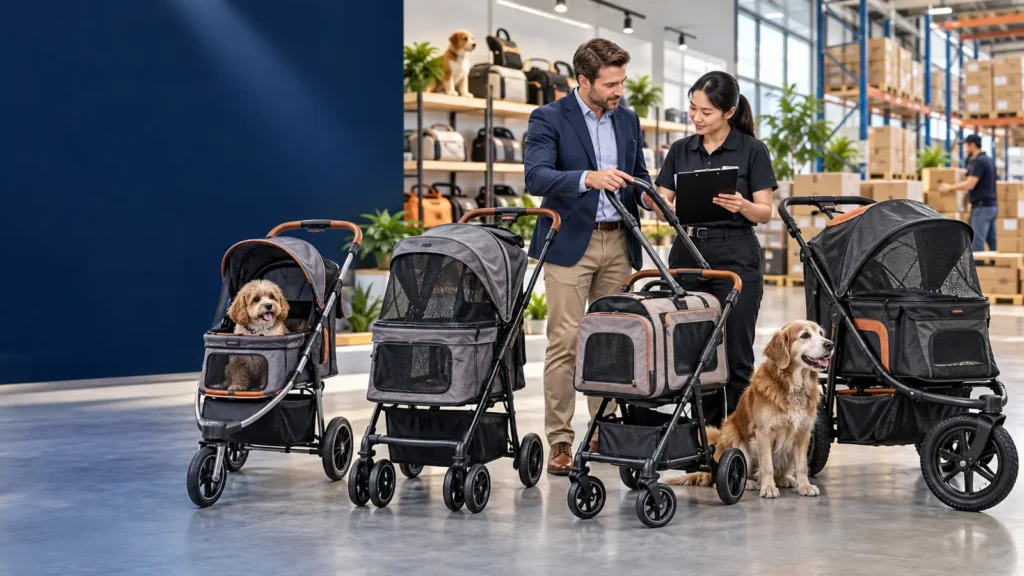
The U.S. pet stroller market offers attractive opportunities for importers, pet-product distributors, online brands and specialty retailers. However, sourcing wholesale pet strollers for the USA is not simply a matter of selecting the lowest FOB price. A successful program must connect the right stroller design with the target customer, sales channel, quality level, packaging method and landed-cost target.
Pet stroller buyers in the United States are not all looking for the same product. Some need a compact stroller for a small dog or cat. Others want a low-entry model for a senior dog, an all-terrain stroller for outdoor use, or a spacious cabin for two pets. Meanwhile, an Amazon seller may prioritize parcel-ready packaging and low return rates, while a regional distributor may care more about assortment planning, spare parts and repeat availability.
This guide explains how U.S. buyers can select pet stroller models, compare suppliers, manage OEM projects and build a more reliable import program from China.
Why Pet Strollers Have a Clear Use Case in the U.S.
Pet strollers serve practical needs rather than being only a lifestyle accessory. They can help owners travel with aging pets, animals recovering from surgery, small dogs that tire during long walks, anxious pets, and cats that need a more protected outdoor environment. Multi-pet households also create demand for larger cabins and higher load capacities.
Several lifestyle factors support the category:
- Urban owners need compact folding products for apartments and vehicles.
- Senior and mobility-limited pets need low-entry cabins and stable frames.
- Outdoor users look for larger wheels, suspension and better maneuverability.
- Travelers value detachable carriers and lighter folding structures.
- E-commerce shoppers expect easy assembly, clear instructions and damage-resistant packaging.
For importers, this means there is no single universal best seller. A stronger assortment covers two or three distinct use cases instead of repeating the same basic stroller in different colors.
Start with the Sales Channel, Not the Factory Catalog
Before requesting quotations, define where the product will be sold. The correct specification for an Amazon private-label brand may be different from the correct product for an independent pet retailer.
Amazon and other marketplaces
Marketplace sellers should prioritize compact cartons, straightforward assembly, clear visual instructions, strong product photography and features that are easy to compare. Carton damage, missing hardware, confusing folding mechanisms and overstated cabin size can quickly create negative reviews and returns.
Pet stores and specialty retailers
Retail stores benefit from attractive display models, intuitive folding, smooth wheel movement and clear good-better-best price levels. Replacement wheels, fabric components and hardware can also make the range easier for retailers to support.
Distributors and wholesalers
Distributors usually need a coherent product family, stable specifications, repeat production and dependable documentation. They may prefer several models sharing wheels, fasteners or fabric colors because common components simplify inventory and after-sales support.
Private-label brands
Brand owners often need deeper customization: exclusive colors, logo applications, sewn labels, retail cartons, manuals, accessories and differentiated features. These projects require more sample approval and change control than a stock wholesale order.
Six Pet Stroller Styles Worth Evaluating
The following product structure gives U.S. buyers a practical starting point.
| Product type | Best application | Important buying points | Typical positioning |
|---|---|---|---|
| Lightweight 3-wheel stroller | Small dogs, cats, urban walks | Folded size, front-wheel tracking, stroller weight | Entry to mid-range |
| Stable 4-wheel stroller | Daily use and first-time buyers | Brake operation, stability, basket clearance | Mainstream |
| Detachable carrier stroller | Travel and multi-use customers | Carrier locking system, handles, base connection | Mid-range |
| All-terrain dog stroller | Parks, trails and uneven paths | Wheel size, suspension, bearings, frame stiffness | Mid to premium |
| Large dog stroller | Senior or mobility-limited dogs | Internal cabin size, low entry, frame capacity | Premium |
| Double pet stroller | Two small pets or separated cabins | Combined capacity, cabin access, folded dimensions | Specialty |
1. Lightweight three-wheel pet stroller
A 3 wheel pet stroller is often the easiest entry product for wholesalers. It can be compact, visually familiar and suitable for small dogs or cats. Buyers should check whether the front wheel swivels smoothly, locks when required and remains aligned after repeated use. A low price is not valuable if the stroller pulls to one side.
2. Four-wheel pet stroller
A 4 wheel pet stroller generally communicates stability and is suitable for mainstream retail. Important details include the rear-brake design, wheel attachment, turning radius and the relationship between the cabin, storage basket and ground clearance.
3. Detachable two-in-one or three-in-one stroller
A detachable pet stroller can combine a stroller frame with a removable carrier, and some designs add a car-seat-style use scenario. The key quality point is the connection mechanism. It should be intuitive, secure and difficult to assemble incorrectly. Marketing claims must match the product’s actual design and intended use.
4. All-terrain dog stroller
An all terrain dog stroller normally uses larger wheels, a stronger frame and improved suspension. Importers should define what “all terrain” means in their own specification. Grass, gravel paths and cracked sidewalks are different from jogging or high-speed use. Avoid broad performance claims that have not been supported by testing.
5. Large dog stroller
A large dog stroller is not simply a small stroller enlarged. Higher loads change frame stress, tipping behavior, braking force, wheel durability and folding-joint requirements. A low rear or front entry, dual access, large mesh panels and a firm cabin floor are especially useful for senior dogs.
6. Double stroller for two pets
A dog stroller for 2 dogs may use one large shared cabin, two stacked cabins or side-by-side seating. Buyers should compare the total permitted load, individual cabin dimensions, ventilation and door access. The intended pet combination should be described using measurements, not vague labels such as “fits two dogs.”
Specifications U.S. Importers Should Confirm
A professional inquiry should include more than a product photograph. At minimum, ask the supplier to confirm the following information in writing:
- External dimensions when open
- Folded dimensions
- Internal usable cabin length, width and height
- Net weight and gross weight
- Declared maximum load
- Frame material and tube dimensions
- Wheel material, diameter and attachment method
- Front-wheel swivel or lock function
- Brake type and operating method
- Number and position of internal safety tethers
- Mesh, fabric and zipper specifications
- Folding lock and secondary safety mechanism
- Storage basket and cup-holder capacity
- Carton dimensions and units per container
- Included accessories and spare parts
Internal cabin dimensions are especially important. A supplier’s weight claim does not prove that a particular animal will fit comfortably. U.S. product pages should tell customers to measure the pet’s body length and sitting height and compare those figures with the cabin—not rely only on breed names.
Load Claims Need Evidence
Load capacity is a powerful sales claim, but it should be treated as an engineering requirement. Ask how the supplier established the rating and whether the approved sample has undergone static-load, dynamic-use, stability, brake and folding-cycle evaluations.
The production specification should identify the test load, duration, surface, speed or cycle conditions, acceptance criteria and sample quantity. For a large model, review the frame, axles, fasteners, wheels, floor board and folding joints as a complete system. Replacing one component after sample approval can change performance.
Avoid simply copying a competitor’s “100 lb” or “150 lb” claim. A defensible claim should be connected to the approved design and test evidence.
Packaging Is Part of Product Quality
For U.S. e-commerce, the retail product may travel through a demanding parcel-delivery network. A good stroller can still generate losses if the carton allows axles to puncture the wall, wheels to rub against fabric or metal tubes to scratch painted surfaces.
A mail-order packaging plan may include:
- Reinforced corrugated carton selected for product weight
- Protection around axles, wheel hubs and folding joints
- Individual bags or sleeves for fabric and painted tubes
- Fixed hardware packs with clear identification
- Corner and edge protection where needed
- Drop and vibration testing appropriate to the distribution route
- Barcode and carton marks placed on flat, scannable surfaces
- Assembly instructions positioned where customers can find them first
ISTA procedures are often used as reference methods for distribution testing, but the test plan should be selected for the actual package, carrier and sales channel. Importers should also compare carton volume because ocean freight, warehousing and fulfillment charges can change the real margin more than a small difference in unit price.
U.S. Compliance and Labeling Considerations
Pet strollers require a product-specific compliance review. A pet stroller is not automatically regulated as a child stroller merely because the word “stroller” appears in its name. U.S. child-stroller requirements are written for products intended to transport infants or children. A pet product should never be marketed or pictured for child transport.
That does not mean pet strollers are free from responsibility. Importers should evaluate applicable federal and state requirements, chemical restrictions, material claims, labeling, consumer-product reporting obligations and contractual retailer requirements. The final determination depends on the product’s materials, claims, design and distribution.
Practical points to review include:
- Permanent identification of the product, importer or responsible business where appropriate
- English country-of-origin marking for imported articles
- Accurate model, lot or batch traceability
- Fiber-content or textile-labeling applicability for covered textile components
- Chemical and material requirements relevant to the product and states of sale
- Clear assembly, folding and brake instructions
- Load limit and intended-pet guidance
- Warning that the product is not designed to carry children
- Tether, parking-brake, incline and unattended-use warnings
- Procedures for complaints, incidents, corrective action and recalls
Companies that manufacture, import, distribute or sell consumer products may also have reporting duties when they obtain information indicating a potentially hazardous defect or noncompliance. Compliance should therefore be managed as an ongoing process, not as a certificate collected after production.
This article provides general sourcing information, not legal advice. U.S. importers should confirm the requirements for their exact product with a qualified compliance professional and their customs broker.
A Practical Pet Stroller Quality-Control Plan
Because there is no single universal pet-stroller standard covering every model and claim, the buyer should establish a written specification and inspection plan before mass production.
Incoming materials and components
Check fabric color, coating, mesh, zippers, frame tubes, plastic parts, wheels, fasteners, boards, labels and packaging materials against the approved sample and bill of materials.
Assembly and functional inspection
Inspect folding and unfolding, locking engagement, carrier attachment, wheel installation, swivel movement, brake operation, canopy movement, zippers, tethers and basket installation. The inspector should confirm that common assembly errors cannot create an unnoticed unsafe condition.
Performance verification
Depending on the model and claim, the test plan may cover static load, dynamic rolling, parking brake, tipping stability, handle strength, wheel retention, curb impact, folding endurance, seam strength and zipper cycling.
Workmanship and appearance
Review stitching, loose threads, sharp edges, burrs, exposed tube ends, scratches, color variation, printed logos and odor. Define acceptable defect limits before inspection rather than negotiating them after the goods are complete.
Packaging inspection
Confirm product orientation, protective materials, hardware count, manual version, barcode, shipping marks, carton dimensions and gross weight. A sealed production sample should remain available as the reference.
Pet Mobility Source can coordinate sample comparison, pre-production checks, in-process follow-up and pre-shipment inspection with verified manufacturing partners. For higher-risk or retailer-specific programs, independent third-party laboratory and inspection services can be integrated into the project.
MOQ and Wholesale Price: What Actually Changes the Quote?
Buyers searching for pet stroller MOQ or pet stroller wholesale price should expect the answer to depend on the degree of customization.
A stock model in an existing color and neutral carton can often support a lower trial quantity. A custom fabric color, printed carton, molded logo component or exclusive structure usually requires higher volume because materials and production must be purchased specifically for the order.
Major cost drivers include:
- Frame size and material
- Wheel size, material and bearing construction
- Suspension and brake design
- Fabric, mesh, padding and floor board
- Detachable carrier hardware
- Load requirement and testing plan
- Logo method and packaging design
- Order quantity and color split
- Spare-parts allowance
- Carton volume and loading efficiency
- Inspection, testing and certification costs
Ask for a quotation that separates unit price, customization cost, sample cost, tooling if any, packaging, testing, inspection and delivery terms. This makes alternative configurations easier to compare.
Calculate Landed Cost Before Approving the Model
The cheapest factory quotation does not always produce the best landed cost. A serious cost comparison should consider:
- Product and packaging cost
- Inland transport in China
- Export handling and documentation
- Ocean or air freight
- Insurance
- U.S. duty and customs fees based on the confirmed classification
- Port, broker and destination charges
- Warehousing or fulfillment fees
- Inspection and laboratory testing
- Expected damage, return and spare-parts cost
For bulky pet strollers, carton optimization is critical. A modest improvement in folded size or carton structure can increase container quantity and reduce fulfillment expense. However, compression must not damage wheels, fabric or the frame.
How to Evaluate a Pet Stroller Supplier in China
Do not qualify a supplier only by website images, a marketplace badge or the statement “we have exported to America.” Request evidence relevant to the exact product.
A useful supplier review covers:
- Business identity and manufacturing location
- Experience with similar stroller structures
- Existing quality-control procedures
- Component and sub-supplier control
- Test equipment and available reports
- Capacity, lead time and peak-season planning
- Sample-to-production change control
- Traceability and complaint handling
- Replacement-part capability
- Export packaging experience
- Communication speed and technical accuracy
The most important question is not whether a supplier can make one attractive sample. It is whether the supplier can reproduce the approved materials, dimensions and function across mass production and repeat orders.
Why Work with a China Sourcing and Project-Management Partner?
Some buyers prefer direct factory sourcing. Others need access to several specialized manufacturers, consolidated shipping and one project team. Pet Mobility Source operates as a China-based pet-mobility sourcing and project-management partner for importers, distributors and private-label brands.
Our support can include:
- Product and factory matching based on target price and channel
- Supplier verification and quotation comparison
- Sample ordering and evaluation coordination
- OEM and ODM specification development
- Logo, color, fabric, manual and packaging customization
- Quality-control checkpoints and pre-shipment inspection
- Test and compliance-document coordination
- Mixed-product order consolidation
- Spare-parts planning
- Export documentation and shipment coordination
This approach is particularly useful when a U.S. buyer wants to combine pet strollers with pet bike trailers, carriers, car travel products or mobility accessories without managing a separate vendor relationship for every category.
Recommended First Order for a New U.S. Buyer
Instead of launching too many near-identical SKUs, consider a focused assortment:
- One lightweight foldable stroller for small dogs and cats
- One stable mainstream four-wheel stroller
- One detachable carrier stroller
- One all-terrain or large-dog stroller
Use a limited number of proven colors, then measure conversion, returns, customer questions and review themes. The second order can add colors or specialized models based on real channel data. Keep a controlled sample and written production specification for every reordered SKU.
Buyer’s RFQ Checklist
Include the following in your request for quotation:
- Target market and sales channel
- Pet type, cabin dimensions and load target
- Preferred stroller structure
- Wheel and brake requirements
- Required materials and accessories
- Estimated first order and annual volume
- Color and logo requirements
- Retail and shipping-carton expectations
- Barcode, label and manual requirements
- Required tests or retailer protocols
- Target delivery date and U.S. destination
- Incoterm requested
- Spare-parts requirement
A detailed RFQ reduces quotation gaps and helps suppliers propose the correct model rather than simply sending a large catalog.
Frequently Asked Questions
What is a typical MOQ for wholesale pet strollers?
MOQ varies by model and customization. Existing models in standard colors generally support lower trial quantities, while custom fabric, packaging, molded parts or exclusive features require larger commitments. Ask for separate MOQ levels for neutral goods, logo customization and full private-label packaging.
Can I order private-label pet strollers for the USA?
Yes. Common options include printed or sewn logos, custom colors, manuals, barcode labels and retail cartons. More advanced ODM changes may include cabin dimensions, frame details, accessories and component upgrades. Approve a final sealed sample and specification before production.
Which model is best for Amazon?
There is no universal best model. Marketplace products should combine a clear use case, reliable folding, accurate dimensions, manageable carton size, easy assembly and strong packaging. A slightly higher product cost can be worthwhile if it reduces damage and returns.
Are pet strollers subject to baby-stroller regulations?
A stroller intended only for pets is not automatically a child stroller. It should not be marketed for children. Nevertheless, other consumer-product, import, labeling, chemical and reporting requirements may apply. Obtain product-specific professional advice.
How should a large dog stroller be evaluated?
Review usable cabin dimensions, entry height, structural load evidence, tipping stability, brake holding, wheel durability, floor support, ventilation and folding-joint performance. Do not rely only on the advertised weight capacity.
Can different pet travel products be consolidated into one shipment?
Yes, subject to supplier locations, order quantities, packaging and shipping schedules. Consolidation can help importers test a broader assortment, but it should be planned carefully to control handling, labeling and documentation.
Build a More Reliable U.S. Pet Stroller Program
The opportunity in wholesale pet strollers for USA depends on disciplined product selection and execution. Define the customer and channel first. Then compare models using cabin dimensions, real use cases, structure, testing, packaging and landed cost—not price alone.
Pet Mobility Source helps U.S. importers, distributors and pet brands source, customize and manage pet mobility products through verified manufacturing partners in China. Send us your target market, preferred models, expected order quantity and packaging requirements to receive a focused sourcing proposal.
Call to action: Request a Wholesale Pet Stroller Quote